Monday, December 17, 2012

Economic Perspectives – Abortion, Retirement and Understanding God


This is long, but bear with me.

I’ve been thinking about the economic impact of abortion for some time now, especially having been told a couple of decades ago that we may have problems when the baby boomers retire. How do those two things relate?

You can find plenty of articles on baby boomers retiring and how it will affect the economy without understanding how that works. But the articles are there. You can also search for articles on abortion and find information on how having less workers has affected the economy. I can’t find too many articles that put the two together in any significant way. But it brings up an issue regarding our ability to balance disparate accounting methods.

This reminds me of an old brain teaser I grew up with:

“3 guys go to rent a hotel room, the room is $30, so they each pay $10. Later that night the hotel guy finds out the room is only $25 so he gives $5 to the bell boy to split between the 3 guys. The bellboy did not know how to split $5 in 3 ways so he kept $2 for himself and gave $1 to each guy so the guys only paid $9 a piece right? So if the guys paid $27 and the bellboy kept $2, where is the other dollar?”

Figure out the discrepancy and you might be able to understand where the money in the economy went.

So let me start out with one observation that is fairly easily calculable: If the children that have been aborted in the US (about 30% of children are aborted) were employed at normal rates, our GDP would be increased by over $39 trillion. Given that, the question I have is what affect do baby boomers retiring have on the economy? It’s not apples to apples accounting to figure it out and I can’t find an estimated figure that relates to GDP loss anywhere. But I can explain what happens when someone retires.

The way we normally think of retirement is that we save a percentage of our income one way or the other. Social Security is supposed to be the government’s way of saving money. (Ha. If you believe that, you’re really in trouble.) But we’ll assume it’s basically the same thing for the sake of simplicity. So people save their money by putting it in the bank, investing it, having 401K accounts, relying on the company they worked for to hold on to it, improving our real estate, etc. We worked hard for it over our lifetime and have it stored up for ourselves. It’s ours and no one else’s. In fact, since we invested it, we’ve made some interest on it so there’s more than what we actually put into it. So when we retire we have access to it. It doesn’t have anything to do with the rest of the economy – except now the government wants more of it… and why are health care costs going through the roof?

That’s the way we look at it and it seems reasonable. It’s a zero-sum game. We expect to have what we worked for. The problem is that we didn’t work for what we need today. We worked for what the world needed then. Today’s workers are making what we need today.

Money isn’t real; goods are. Money accounts for the goods we can expect to receive. The percentage of money that we have today out of all the money in the economy entitles us to the same percentage of the amount of all goods that are produced today. So if less goods are produced or our percentage decreases as the total amount of money inflates, our money is worth that much less. If you want more goods, you need more people making the goods. More people? Those are the tens of millions that have been aborted, by the way.

Let me illustrate simply.

1 - Let’s say that we have a population of for people – two couples. There are four people producing enough to support four people. More than enough.

2 - So they reproduce. Let’s say they each have only one child. That’s four people making enough to support six people. Still more than enough.

3 - Those children grow and start working. That’s six people supporting six people. Plenty to go around.

4 – The kids get married and have one child. Six people working to support seven people. Still good.

5 – The first generation retires. Two people working to support seven people. Oops. We have trouble. That’s not enough. The working population has decreased by the amount necessary to support the whole population. If one of the two becomes pregnant to try and raise up more workers for the future, that leaves one to try and support all seven people.

Everyone suffers at this point. Didn’t the first generation make enough extra to keep them in their retirement? Goods only last so long. Houses need to be kept in repair. New food needs to be produced. New clothing needs to be fashioned. The extra goods they worked for are in need of replacement and there’s precious few to do the replacing.

That’s what we are facing today. When money is invested, it doesn’t go under a rock or a mattress and gather dust until it’s needed. It’s placed in the economy as capitol for generating growth. When it’s removed, the growth goes away and the market shrinks. But what growth can we expect if we have fewer workers.

The argument can be made at this point that plenty of people are unemployed and need work. The problem is twofold.

First, moral decline has created a generation that doesn’t want to work hard. Some want the hours so they can have the money, but many aren’t willing to put in the work to warrant the money make for working the hours. Some want extra pay and benefits beyond what is reasonable, so they unionize and extort as much as they can from the bottom line of the company. Meanwhile, they make rules that make them have to work less for it. They are less productive. There is a class of potential workers that are made unusable by the drug and crime culture. The businesses that remain viable in the US have plenty of people to hire, but few worth hiring.

Second, there is great incentive for people on unemployment to remain on unemployment. I know from experience how we try to hire someone who doesn’t want the job, but only needs to prove that he was looking for one in order to keep getting the check. The taxes that pay for him to do nothing are slowing the economy such that fewer businesses are viable. The flow of money is down enough to keep business from being able to sell what they need in order to open.

I want to take this around and use it to make an observation on how we understand God. I’ve just took a couple of very simple glances at the economy from two different perspectives. I hope you’ve followed along. It’s informative to know our little place in the grand scheme of the economy and why our income is not a zero-sum game. It can be treated as such for miniscule budgeting purposes. In fact, it’s prudent to do so. But when we plan long-term, there are things we can never be certain of. We can stockpile all kinds of proverbial grain for the future and return only to find it infested with worms. Our investment shouldn’t be only in money, but in the culture. Are we producing the kind of culture that will provide when the future comes?

Looking at our relationship with God is usually like playing the zero-sum game. We see things with God from a human perspective. Indeed, God gives us human examples to help us understand our relationship with him. Perhaps we see how people could be so saddened by Jesus’ death on the cross and use this emotional sacrifice to understand how much God loves us. But really, God’s love goes far beyond any emotion that we are familiar with.

The very words “propitiation”, “atonement”, and “penal substitution” speak of human things that help give us an idea of what God was up to in the cross. We know what a bank account is like so we can understand that Jesus paid money into our spiritual bank account. We know what punishment for wrongdoing is, so we have an understanding of Jesus being punished on our behalf. But these are physical images of a spiritual truth.

Questions we have about God of things that seem contradictory are because we expect a logical zero-sum game. The presence of sin in the world has skewed the relationship between our personal connections to God (like our personal budgets) and the overall purpose of God to glorify himself in all of creation (the GDP). I have a buddy that says that the human perspective is all we have available and that’s all he can understand. He’s an accountant, so what can do about that?

Nevertheless, we are given glimpses of God’s perspective in his revelation to us in the passages of scripture. It doesn’t take the suspension of disbelief to understand these things, or delude ourselves into believing that we understand God when we really don’t. We can understand God when we understand that it’s not a zero-sum game.

Now that’s a perfectly nebulous thing to say, but it’s accurate. The difference is in our ability to wade through the cloudiness that our sin causes in this world and view the world through the purposes of God.

For example, we tend to talk about God in personal terms: “I give testimony about what God did for me and how my life has changed. And now you need to do what I did so that you can have Jesus in your life too.” The other side of this example is a small look at what God sees in this exchange: “The Spirit has motivated me to tell you my story about the gospel because that’s something that you can relate to. The same Spirit is now working in you to move you to respond in faith.”

To many, that sounds like we’re only puppets. However, God is not functioning on the same level that we are. But when we realize that it’s God working on his level to cause what happens on our level, we realize that only a God with that kind of power can be trusted to fulfill his promise. So understanding God truly requires an ability to navigate both the physical and the spiritual. So we are given the Holy Spirit of God himself to help us.

I hope this helps you understand God a little better. This was only one example. There are so many more. I hope you devote your lives to understanding how great God is in how he works in your life to glorify himself.

Does God Allow Sin?

I caught a link to an article on the Ligonier site that deals with this question from the Triablogue site.

This is the Ligonier article: Why? The Nagging Questionby Paul Helm
This is the Triablogue post that linked to it: Why? The Nagging Question

The reason I included the Triablogue link is that Ligonier doesn't open their articles for comments from the peanut gallery. Triablogue does. So I posted a comment to the Ligonier article on the Triablogue post. Clear as mud? I'll also copy my comments here because this isn't an area I've written about in much detail. These comments summarize some of my thinking on the nature of sin and evil, what we have to do with it and what God has to do with it. There is much more to be said about this, but this is a foray into this topic that so often confuses us.

I'm convinced that our understanding of evil is not fully developed. We can draw certain conclusions from Joseph's distinction between acts of evil and intent. Much of what we consider to be acts of evil are evil only in context of being performed by fallen men in particular situations. There's no difference between the act of adultery and the act of marital sex except the context of a committed relationship defined loosely enough that we debate divorce and remarriage within the Body of Christ. If the ceremony were enough to warrant a commitment, then we have problems. Additionally, as fallen humans, none of us enters into a committed marriage without importing our own sin. I only mention this by way of example. The issue of evil becomes extremely complex if our goal is to merely to behave well and call ourselves good.

On the other side is the knowledge with Joseph's distinction that nothing we do is truly good because it is always laced with sinful intent and everything God does is always good. for us, even though we may have a core desire to do good, we are not unilateral creatures. There are always tangential desires that creep in. How many of us can say that we are not motivated in the least by a desire to share some of the glory with God for doing something well in his name? Even every act of humility has an element of false humility as long as we need some element of sanctification.

The balance in a fallen world is that some acts carry the weight of divine justification. God could call his people to kill for the right reasons and be held accountable for not doing so. By saying this, however, there are many who would look at their sin and try to find justification for it where scripture can be twisted to that end. This can only be divine justification. It was the penitent prayer of the tax collector rather than the falsely righteous prayer of the pharisee that received justification. They were still sinners. The pharisee thought his good behavior was worth something. Indeed, we should vie for good behavior, but the best among us have no greater cause to stand before God unashamed. Thanks be to Jesus Christ because he stands with us.

One further observation is that

1) if behavior by itself is not evil
2) some acts are justified because of an evil world
3) God never sins
4) Everything we do is laced with sin
5) Acts are caused by both God and us

Then things that are evil for us to do are not evil for God to do. This is what typically troubles us, but it follows if 1-5 are all true. We want to be able to say that we can be as good as God by exhibiting good behavior. We also want to say that God can do evil when we must live in a world that is cursed and difficult because of the sin of our father, Adam, that we have perpetuated generation after generation since then by the mere fact that we have been born separated from God. So it is our guilt that must be addressed, not God's. So even if God directly causes our difficulties, it is on account of our sin, not his.

Friday, December 7, 2012

Why Do We Educate People?

Al Mohler published a blog article recently about the inequality of families with good parents versus bad parents:

President Hollande wants to end homework in order to level the playing field for the nation’s students. As France 24 reports, Hollande told an audience at The Sorbonne, “An education program is, by definition, a societal program. Work should be done at school, rather than at home.”
He went on to explain that it was unfair for students with parents who are engaged with their schoolwork to gain an educational advantage over others, whose parents do not offer such support.

Dr. Mohler points out correctly that good parents are important for their children, even beyond the quality of education that they receive.

However, I want to take this in a different direction. Dr. Mohler, in summing up President Hollande's statements, points out that it is "unfair for students with parents who are engaged with their schoolwork to gain an educational advantage over others." (emphasis mine) The implication is that education is a matter of competition. In this view, the goal of education is to do better than others so that you can help yourself.

My understanding of education has always been that the goal is for each student to do better at the end of any course of study than what they did at the beginning. In other words, the goal of education is a personal struggle against ignorance.

But that's not and end in itself. There's a larger goal. While we improve ourselves the goal is to contribute positively to society thereby helping others, not defeating them.

An observation I've often made is that it seems more acceptable to tout some talents than others. For example, it seems relatively acceptable for a good leader to say, "I'm good at leadership." But one talent it seems particularly unacceptable to tout is intelligence. If someone says, "I'm exceptionally intelligent," he or she is quickly labeled arrogant. The fact is that some people have a natural predisposition to great intelligence. For some reason people don't think that's fair. And this doesn't figure into President Hollande's idea for a "level playing field."

But this betrays the fact that it is fairly common to think of education, not as a benefit to society, but a benefit to individuals over others. The reason is because many people use greater academic achievement not primarily for the betterment of society, but for their own advancement in society. What most in secular society will ignore is that this is precisely evidence that people are basically evil.

So what are Christians to do?

First, we must recognize the God-given responsibility we have to train up our own children.

Second, we must vie to help them get the best education possible with the goal not of improving their own status, but for contributing positively to society, particularly in the fulfillment of the Great Commission.

So we have to stop looking at education as the means for achieving the best life for ourselves on this earth ans start looking at it as a means for drawing us closer to God by using our talents to help other people.

Monday, November 19, 2012

Old Earth Theology – What the Early Church Fathers Taught


This is the final post on a series about Old Earth Theology. This first post is here.

The teachings of the early church fathers are not part of the inspired text. However, as the beginning of our church traditions, they are a study in how orthodox Christianity is understood and taught. So it is interesting to see how the church fathers interpreted Genesis 1.

To this end, there is a good book out that has a chapter that discusses it. It’s entitled Coming to Grips with Genesis: BiblicalAuthority and the Age of the Earth. It’s a collection of 14 articles by various authors in support of YECm. The first chapter written by James Mook details the teaching of the early church fathers on Genesis 1.

Dr. John Millam, an OEC, has a reasonable critique ofMook’s article. I always like to balance arguments with critiques and responses from the opposing side. The side who ignores good arguments from the other side is suspect. While Millam has a good critique, it’s not sufficient as an argument for OECm. Some of the church fathers taught that the days were 24-hour periods of time. Some taught that they were figurative periods of time. In looking at the evidence, however, I found out that the figurative “days” in Genesis 1 were never explicitly taught as long periods of time prior to Adam and Eve. Instead, they taught them as a type of eschatology.

I have never heard of this before, so I have had to study this. This type of eschatology was widely held by various Jewish sects although they differed on the particulars. It was especially popularized by the rise of the teaching of the Kabbalah, a school of thought that taught a form of mystical exegesis. Some scholars argue that the Kabbalah was the origin of the doctrine of the Trinity. I think that theory is in error. But I also think that mystical exegesis is in error. Although the Kabbalah helped popularize the eschatology of Genesis 1, that understanding doesn’t rely on the Kabbalah for validation.

In fact, varieties of eschatology that use Genesis 1 are different enough that it’s not wise to speculate on eschatology on that alone. However, whether the church fathers were YECs or not, it seems most likely that the eschatological understanding was more important to them. Given that one of the differences concerned the day the Messiah was to come, the church fathers certainly understood that he had already come in the person of Jesus Christ.

But I’ll say it again: none of the church fathers taught any form of an old earth creation. Granted that there are problems with using them to support a young earth as Millam has pointed out, but even some of Millam’s arguments are questionable. For example, he argues that while the early church fathers never taught an old earth, he doesn’t think that they would have rejected it either. The appeal to this comes oddly after an attack on their hermeneutics as apparently being vastly different. You can’t have it both ways. If you say that someone’s interpretive method is questionable, you wouldn’t want to say that you think they would have supported your position as evidence that your position is correct. So obviously Millam respects the church father’s understanding of scripture. Given that never taught OECm, and some were explicitly YECs, then the evidence suggests that as a body, they would more likely have accepted YECm.

Additionally, given that some taught that the “days” of creation were allegorical of all of creation, they believed that creation consisted of about 6000 years with a seventh indefinite period of time after the resurrection. What aspects of that are accurate is a different discussion. It’s intriguing to think that perhaps the millennium in Revelation 20 refers to the sixth or seventh day of creation. Just don’t tell the strict dispensationalists. That could stir up a hornet’s nest.


Thursday, November 15, 2012

Old Earth Theology – Who Is Making the Arguments

My first post on this series is here.

There are two basic sets of arguments that contribute to an old Earth theology. The first set contains arguments that are scientific in nature. The second set contains arguments that are theological in nature. Quite simply, there are two different groups that make each of these arguments.

Naturalists and Theistic Evolutionists

The mainstream scientific school of thought is dominated by scientific thought that relies on naturalistic presuppositions. That means that before any conclusions are drawn from testing, any supernatural explanations are automatically denied. The untested theory is that the supernatural cannot be empirically tested. The non sequitur conclusion is that only natural explanations are possible.

It is from this philosophy of science that Darwinian evolution draws it’s a priori conclusion. So the question is not whether organisms evolved naturally from inanimate matter. The question is how they evolved from inanimate matter.

Given that even non-biological science is naturalistic, sciences that are not directly related to Darwinian evolution still assume that Darwinian evolution occurred. Therefore, when physicists and geologists test to determine the age of the earth, they must assume that it is old enough for life to have evolved. Therefore, any evidence that the earth is young is dismissed as anomalous or not yet explained.

There are naturalists who otherwise believe in a supernatural Creator. Some may even be Christian. However, they hold any claims of Christianity to be untestable because they don’t fit into the naturalistic presuppositions that they have been taught define science. If you want to work in mainstream science you largely have to buy into naturalistic presuppositions to be accepted.

Non-Evolutionists

The theists who argue for an old earth are the ones who argue from a scriptural standpoint. The question I have always asked is why they argue for an old earth when the scriptures don’t explicitly teach that. The plain reading of Genesis 1 is that God created the earth in 7 rotations of the earth as denoted by the period of the sun. In fact, these theologians go out of their way to deny that Genesis 1 doesn’t mean what it seems to say.

The only reason I can think of why they do this is that they have heard some of the evidence for an old earth and an old universe and are convinced by it enough to see if the scriptures make allowance for the current mainstream science on the matter. What I haven’t heard a single one in this group address is the evidence for a young earth. The only thing I can conclude is that they haven’t heard the evidence for a young earth because mainstream scientists typically don’t address it.

The Science Isn’t Conclusive


The thing is, there is some compelling evidence out there that the earth is relatively young. Not all scientists are naturalistic. Some Christian scientists actually work on the fringes and conduct experiments using science that is based on non-naturalistic presuppositions. That means that they allow that there may be a God.

Answers in Genesis has been a clearinghouse for non-naturalistic science, particularly as it relates to the origins of the universe, the earth, and life. Recently, they have been repackaging some of the leading evidences for a young earth. I’ll repost their top ten list here:

  1. Very little sediment on the seafloor
  2. Bent rock layers
  3. Soft tissue in fossils
  4. Faint sun paradox
  5. Rapidly decaying magnetic field
  6. Helium in radioactive rocks
  7. Carbon-14 in fossils and diamonds
  8. Short-lived comets
  9. Very little salt in the sea
  10. DNA in “ancient” bacteria

Another consideration that I think trips many people up is the age of the universe versus the age of the earth. Many scientists, much less laymen, think that time throughout the universe passes relatively uniformly. In our day-to-day life it certainly seems so, so it’s understandable that it’s a difficult concept for most people to grasp.

But vast differences in the passage of time are far more common than most people think. The spectrum of electromagnetic radiation (visible light and various radio waves) is nothing but temporal distortions generated by subatomic interactions that approach the speed of light. What I’m trying to say is that the universe could easily have been created after the earth and aged so fast that it appears older than the earth. It’s not scientific fiction and actually explains a few things that the Big Bang theory can’t account for. There are some that think this theory is far-fetched, but it’s actually a more likely explanation for the evidence than the Big Bang.

What I’m trying to say is that there’s no good reason to believe the naturalists on the age of the earth without question. They have some legitimate observations that can’t be ignored. But those observations have their own problems. Naturalistic science should be scrutinized. Theology that goes out of its way to accommodate it should be scrutinized as well.

My next (and last) article in this short series will discuss what the early church fathers taught regarding Genesis 1. You might be as surprised as I was when I first read it.

Tuesday, November 13, 2012

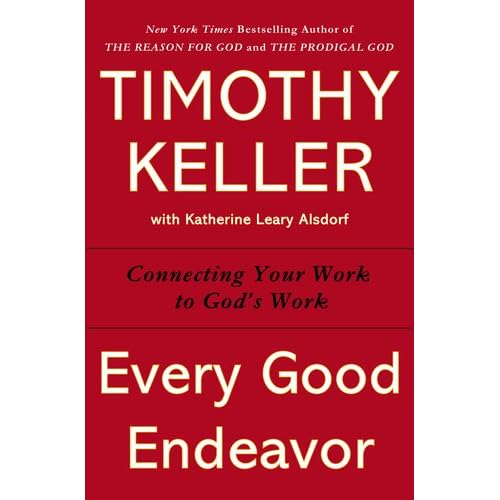
Dr. Timothy Keller book: Every Good Endeavor

There’s a deep disconnect between the lives of many church members and many pastors. I don’t think it’s wrong for a man to go from high school straight to college, and from there straight to seminary only to wind up leading a church with very little work experience outside the church. Many of the men who have done so have become very good pastors.

But church members have careers, jobs, vocations, occupations, or whatever you want to call what they do with the majority of their working time, away from anything remotely related to the church. Men especially tend to identify with their work. If they identify with their work and their work is not related to church, then they experience that disconnect I mentioned. Church is something they visit once or twice a week. “Real life” isn’t church.

I’m not sure most pastors have a clue. As long as they see people in the pews everything seems okay, that is until that person falls into some sort of sin. When that happens the pastor is left baffled as to how this person could have turned without realizing that this person has a more significant identity outside of the church.

Dr. Timothy Keller has made some inroads into this mysterious area of church life with a new book Every Good Endeavor: Connecting Your Work to God’s Work.

Based on short biographical sketches, Keller seems to be one of those who doesn’t have much of a work history outside the church. Having not read the book, I don’t know if he covers everything well, but he gave an interview to Desiring God where he discusses some of the points in his book. If this is any indication, then he seems to handle the theology very well and accurately assesses the impact of culture on our working world.

God's Work and Ours: And Interview with Timothy Keller

Based on this interview it’s probably worth reading on those aspect alone. I plan to get hold of this book and read it. It might be worth your while as well.

Monday, November 12, 2012

Old Earth Theology

As a matter of full disclosure from the beginning of this, I’ll let it be known that I’m a Young Earth Creationist (YEC – I’ll refer to Old Earth Creationists as ‘OEC’).

Additionally, to limit any discussion to the topic at hand this series is about the differences between Old Earth Creationism (OECm) and Young Earth Creationism (YECm) between Christians. It will involve some of the science surrounding this topic and will assume that naturalistic evolution has not occurred. So that eliminates discussion of theistic evolution. It’s not that I get many commenters here, but I have a very specific topic that I wish to discuss. I won’t entertain discussion otherwise here.

I have thought about this for a number of years now. The topic of the age of the earth is one that seems fraught with a lack of understanding. Most of the time when I read or hear an OEC explain why he or she believes OECm, the rationale typically given is limited to arguments regarding the exegesis of Genesis 1.

The problem with this approach is that an exegesis of Genesis 1 devoid of scientific considerations results in interpreting each ‘day’ as a single rotation of the earth. In other words, the exegetical arguments that result in a gap between verse 2 and 3 (the Gap Theory), or interpreting each of the days as referring to very long unspecified periods of time, are obviously informed by some information that the OEC isn’t disclosing.

The reason it seems is that OECs think it goes without saying that science has absolutely proven that the earth is old, but they aren’t prepared to discuss the science because they are theologians, not scientists. They haven’t studied the science in any depth, but what they have seen appears to have been pretty convincing to them. Most OECs that I have read or heard merely dismiss the science with statements such as “Well, Genesis 1 isn’t a science textbook.” I can only interpret that to mean, “I don’t understand the science, but it seems to me that scientists have proven that the earth is very old. Genesis can be interpreted different ways. It’s not a deal-breaker. Therefore, I can say that the earth is very old without changing the gospel. That’s so scientists don’t think I’m an idiot and other Christians won’t think I’m a heretic.”

The view of YECm is that a plain reading of the scriptures are that the days are single rotations of the earth and that the science isn’t conclusive.

The only non-theistic evolution OEC that has addressed the science that I have seen merely said that the science for the age of the earth is not encumbered with the same naturalism as Darwinian evolution is. Therefore, he concluded, we can accept the conclusions without delving into the intent of the scientists. The only problem I have with that is that many of the scientists whose work contributes to calculations of the age of the earth are Darwinian evolutionists otherwise and invested in an old earth a priori to testing and analyzing data.

The point of this article is simple. I have some sources that I have reviewed regarding arguments for OEC. But I may not have them all. I have reviewed plenty for the exegesis of Genesis 1, but can find very little other than what I have mentioned for importing scientific conclusions into the exegesis of Genesis 1. If anyone reading this knows of some better argument for OECm, please let me know. I’d like to interact with it and post my findings. I’m looking for the best arguments for OECm if any are out there that I haven’t found. Post links or resources in the comments and I will review what I understand.

What I plan to cover in the future is how the early church fathers handled Genesis 1 (in general) and how the science is not conclusive. If anyone comes up with a better argument than I have seen, I’ll include it as well.

Edit:
The second article discussing who (in general) is making the arguments can be found here.