Reactions to the landscape of Christian life from a Protestant Reformed perspective.
Monday, May 26, 2014
They Seem To Be Used Interchangeably
Hermeneutics: the art of analyzing and interpreting the meaning of text. This is a key element to discovering what it true according to the Bible and vitally important to developing Christian doctrine.
The title of this article, They Seem To Be Used Interchangeably, is often offered as an argument for accepting some types of doctrinal conclusions. That is to say that where a couple of different words are used in similar contexts, whether the two words mean precisely the same thing bears some relevance on determining the meaning of the passage.
There are two common examples from scripture. One is when “love” translated from two Greek words, “agape” and “phileo”, in the common American reference to them. Another example are the Greek words, “psyche” and “pneuma”, translated as “soul” and “spirit” in similar contexts respectively. In the “love” argument, the difference in doctrinal conclusions is whether or not to make a distinction between God’s love and the love of the world. In the “soul and spirit” argument, the difference in doctrine has to do with whether man is made up of three parts: “body, soul, and spirit”, or only two parts: “body and soul/spirit”.
One of the problems I have with making such sharp distinctions is that such argumentation ignores the subtle nuances of interpretation when words overlap in meaning but are not precisely the same. I’ll offer here a couple of neutral examples of what I mean.
I have used in the past a stark example of how words can appear interchangeable but mean completely different things. I drive a red Ford Focus. It’s a common car and gets good fuel mileage. That means that it’s relatively cheaper to purchase, maintain, and operate than many other cars. What if I say of my car, “My car is red.” What if I say again later that, “My car is a Ford Focus.” If you knew what the word “red” meant, but had no idea what “a Ford Focus” was then perhaps you might be inclined to conclude that “a Ford Focus” was the color “red”. Perhaps you thought to yourself and realized that the two statements might be referring to two different categories. You would be correct, but you could still get into trouble if you though to yourself that all Ford Focuses were red. Using such a stark example, I hope you can see how both are obviously silly conclusions.
I have a more subtle example that brings this observation to bear on the hermeneutical argument. In my town of Statesville, NC, West Front Street is an industrial development serviced by a train that runs between the industrial properties. I can say one of two things that mean the same thing. I can either say, “There is a train that runs along West Front Street,” or I can say, “There is a railway that runs along West Front Street.” Both statements refer to the exact same thing. All I have done is replaced “train” with “railway”, and both terms refer to the system of rails, cars, and engines that transport goods to and from industries along West Front Street.
But let me use those very same terms in another statement. I can either say, “We need to do maintenance on the railway, “ or “We need to do maintenance on the train.” These two statements mean somewhat different things. The first statement indicates that we need to go out and repair or renew some segment of the tracks on which the train runs. The second statement indicates that we need to repair or renew some aspect of the cars or engines that run along the rails. While these terms can be used interchangeably in one context, they refer to somewhat different things in another. I say “somewhat different” because the terms are still related.
It is for this reason that I hold this argument suspect in biblical hermeneutics. If I observe similar usage of different terms, I will observe how they are used. If there is sufficient reason to conclude in one place that they are referring to the same thing, then so be it. However, I won’t presume that two terms always meant the same thing in every context. For the examples I have given, I believe it is a logical error to conclude that different terms used as referents to the same thing in one case will always refer to the same thing in other cases, especially if a doctrinal conclusion hinges on it.
Being Strong and Delicate on Sin
When dealing with the sins of brothers and sisters in Christ, we must be both strong and delicate.
We must be strong on sin.
That is to say that we must be clear on what sin is. This goes two directions:
First, we must understand what particular sins are. Unrepentant sinners typically don’t like for their sins to be called sins. They will be angry. They will consider your recognition of their sins as a sin in and of itself. They will persecute you, if possible, for calling out their sins.
Second, we must understand the nature of sin as part of the nature of fallen man. It’s not enough to point out individual sins, but we must understand that those individual sins are fully seated in the identity of sinners. We must be clear that we are all sinners in this way. The only difference is that those who have faith in Christ are forgiven based on his work on the cross and are subsequently reconciled with God.
But it’s precisely because of this point that we must be clear on what sin is. If we don’t get sin right, we don’t get the gospel right. If we don’t get the gospel right, we fail to convey the truth of it to those who are yet perishing in their sins. Without the truth of the gospel there is no way they can have enough understanding to have faith in Christ. It is precisely recognition of sin that brings recognition of our need for Christ. So we must be clear about sin.
We must be delicate with sin.
Being clear on sin doesn’t mean fully appreciating every little sin we commit. Even in the Law of Moses, sacrifices were offered for the forgiveness of sins that people were not aware of. Paul addressed people who had already come to faith with the revelation of sins they were committing unawares up until that time. As we go through life walking with Christ, spiritual growth necessarily entails learning of sin s we have been committing that we are now able to be discipled about effectively. The Holy Spirit, who guides us through this process, knows when to reveal sins to us in due course of our life as Christian believers.
As we live in community with other believers, and at home with Christian families, we must necessarily bear each other’s sins delicately. That is, if we are to agree with the Holy Spirit, we need to be sensitive to his guidance in pointing out the sins of others lest we reveal a sin before its time. Some obvious sins must be dealt with swiftly. Others must take time and an understanding of how that sin fits in with the development of another. If we are strong in minor sins and swiftly deal with them too early, a Christian who is not mature enough to handle certain sins may become undone or develop a resistance against dealing with sins and become weak in recognizing sin instead of stronger.
More could be said on this, but it is best to stay in prayer for your brothers and sisters in Christ to whom you have been given to live in Christian fellowship that you have guidance from the Holy Spirit to handle sin wisely, with both strength and delicacy, understanding that you should be also undergoing the same growth in other areas.
Saturday, May 17, 2014
Is God In Time?
If you want a good radio program to listen to each week,
you should listen to Greg Koukl’s program
produced by Stand to Reason. He
addresses some of the current events from the standpoint of a Christian
apologist and he is always thought-provoking.
It’s trite say that I don’t always agree with him on
everything. However, it’s of a matter that I disagree with him that I want to
address. This episode can be accessed here.
Click on the link at the bottom of the short article
listing what topics he discussed to download and listen to the program. In the
list, caller #3 brought up a topic about whether or not God is in time. Greg’s
response is that he is in time. To support this assertion, he asked a question:
“Does God count?” If you answer no, then you must affirm that there is
something that God cannot do. This appears to contradict the omnipotent nature
of God. If you answer yes, then counting requires time for that kind of
sequential reasoning. The caller was stumped by the question at least for the
duration of the call and Greg used the lack of response from the caller to
elaborate on his point somewhat.
I know a little bit about time. I majored in physics and
particularly excelled in special relativity. I also studied philosophy later
on. From that perspective, I can say that philosophical considerations of time
are burdened by the generalization of the flow of time as experienced
macroscopically. That is to say that all of us as human beings living on the
surface of planet Earth experience the flow of time in a generally uniform way.
We make exceptions for time zones and the perception of time due to situational
circumstances, but when an hour passes for me, it can be said that an hour
passes for everyone else. When we think of a long time, we might think of a
span of years out our lifetime, or even centuries or eons of history. As long
as time has always passed the same as it has now, our imaginations can do a
pretty good job of providing an accurate assessment of what happened. When we
think of time, that’s what we think of.
So is God in time? Answering that question requires that
we have an accurate concept of time. While the concept of time that I mentioned
above is not entirely inaccurate and typically helpful in carrying out our
everyday lives, it’s not helpful in addressing whether God is in time or not.
So we need to answer another question first: Is there a
more refined understanding of time that we can know? The short answer is yes.
The long answer involves discussing what that understanding is and how it pertains
to the question of whether God is in time or not.
First of all, this understanding has not always been
known. The implication is that this understanding is not important for having
faith in God or understanding what is important about him. Previous generations
didn’t need this understanding. The scriptures don’t go into detail about this
although there is enough information to hint at the refined information while
using normal experience to convey God’s relationship to a fallen creation as
Creator, Provider, Redeemer, etc. We can know THAT God is involved with the
world without understanding HOW God is involved with the world.
What we know about time is brought
to us by testable and observable science. Now science cannot give us knowledge
with absolute certainty. It can only give us knowledge that has a likelihood of
being true based on a set of predetermined criteria. That which is testable and
observable, like devising carefully planned laboratory experiments to test
hypotheses, yields the highest likelihoods. That which is observable but not
testable, like the social habits of gorillas in the wild, yields a high level
of likelihood if conclusions are restricted only to what is observed. Many scientists
make speculations based on non-testable observations or employ non-observable
assumptions in the initial conditions of their experiments and call it
observational science. Things like global warming or the age of the universe
fall into this category. The likelihood of these speculative conclusions cannot
be determined. Therefore we assign terminology such as “educated guess” or “professional
assessment” to these kinds of speculations. The conclusion of someone trained
in a field is reasonably more likely to be right about something than someone
not trained in that field. However, I will reiterate, we have no way of
measuring such rightness. In other words, we have no way of knowing for sure.
There is one other area of knowledge that we can use.
This is theoretical science. Theoretical science uses the conclusions of
testable science to develop either untestable conclusions or testable
hypotheses. When a theoretical scientist adds a single element of speculation, (s)he
crosses the line into speculative science. As long as theoretical calculations
remain based solely on testable conclusions, the likelihood of the theory being
true is fairly high. The knowledge of time that I will explore here relies
exclusively on testable and theoretical science.
Parenthetically, as materialism is not provable, I am not
given to it. It is assumed that the material world will behave in predictable
ways. Otherwise, testable science is irrational. However, the material world
can still behave in predictable ways while there is yet more to reality than
the material world. During anomalous events where something other than the
material world affects the material world, even testable science is unreliable.
This is not germane to this discussion and I won’t discuss the ramifications
here, but it bears mentioning in any discussion of testable knowledge.
From testable science, we know that time is affected by
relative motion. The faster something goes relative to something else the
greater the differential between their respective temporal frames of reference.
That is if you saw a clock speed up to close to the speed of light, you would
observe that the time on the clock slows down relative to the watch on your own
wrist. There’s a paradox that will bake your noodle, to quote a popular movie:
that is that if someone else were traveling with the clock, they would observe
your watch moving more slowly than the clock they were with. Now, in one respect,
this is merely an observational effect. That is to say that you both are
actually experiencing the same passage of time, but the light from each of you
takes longer to get to the other because of the change in distance.

However, there is an actual differential in the passage
of time. In a famous experiment, synchronized atomic clocks were sent on
flights in different directions. When they were brought back together, the time
between them was different. Another observation was made in the engineering of
the cathode ray tube. This tube was the display device that made the first
television technology possible and has been used until the recent advent of
LED, plasma, etc screens. An in the tube and electron gun is used to fire
electrons onto a screen where pixels would be illuminated by the electrons. In
order to aim the electrons at different pixels on the screen they would be
fired through a magnetic field that would change their direction. The field had
to be calibrated precisely. The engineers at first calibrated the field
according to a uniform passage of time. However, it wouldn’t work. The electrons
weren’t going where they were supposed to. They discovered Einstein’s theory of
relativity and applied a transformation formula to account for a difference in
temporal frame of reference between the moving electron and the stationary tube
apparatus. It worked and has worked since. Therefore, some differential in time
must be in play.
And it makes sense. It has been tested and observed that
the speed of light is the same regardless of the difference in movement between
the source of light and the measuring apparatus. This has become a governing principle
of special relativity. That is to say that if you were in a car with the
headlights on and you approached the speed of light driving forward, light
would not build up in front of the car as you continually caught up with the
light emitted from the headlights. As far as you could observe, light would
continually move away from you at the speed of light. For an observer standing
on the side of the road in the distance, light would reach them from the car at
the speed of light, not at the speed of light plus the speed of the car. The
only way to account for the constant speed of light is to adjust the passage of
time for car and stationary observer. Time would pass more slowly for the car
than the observer.
Now, this is difficult to think on in macroscopic terms
because we simply don’t experience such dramatic speeds. But on a subatomic
level, these speeds are normal. The movement of a subatomic particle is the
energy that it has. If it absorbs energy and increases to a level of motion
that approaches the speed of light it will appear to the particles surrounding
it as though it slows down, or looses energy. Given the laws of thermodynamics,
the energy cannot be lost in a system, which includes a single temporal frame
of reference. So what happens to the energy? This question, in particular,
pertains to electrons that whiz around the atomic nucleus with alarming speed.
When energy of some sort is absorbed the by electron, it increases in speed
such that it appears to lose energy relative to the rest of the atom. With the
loss in energy, it drops to a lower orbital shell and emits a photon of light perpendicular
to the plane of centripetal movement. The photon travels for a time according
to the distance between the atom of origin and the particle the photon hits.
The energy of the atom is absorbed by the receiving particle.
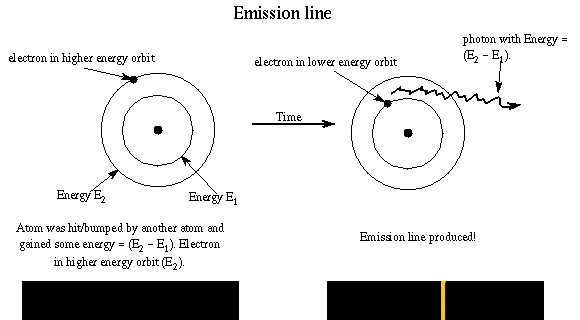
To theorize from the perspective of the frame of
reference of the electron, the distance between the electron and the particle
that its lost energy is transferred to is nullified. There is no photon to the
electron. There is only the receiving particle. The photon is like an accountant
that equalizes the difference between extremely diverse temporal frames of
reference. In fact, the same formula that describes the difference between
temporal frames of reference can also be used to describe the difference in distance
between temporal frames of reference. At this point, time and distance become
interchangeable.
This effect is extremely common. The light hitting your
eyes as you read this is following this same course. The radio signals that you
use in your wifi, your cell phone, and countless other devices in this world,
are using photons of electromagnetic radiation that follow this same pattern of
temporal accounting. There are so many particles of electromagnetic radiation
crisscrossing your body at any given moment, that your experience of time is a
tapestry of temporal extremes homogenized into a single macroscopic temporal experience.
This is such an astonishing thing to consider that scientists have speculated
that there is only one electron in the universe and shares its existence throughout
all things by virtue of its extreme temporal experience.
In fact, on the most foundational level of matter, the
difference between matter and energy becomes interchangeable. Energy,
therefore, is a material thing. This is how we were able to develop atomic
energy by converting matter directly to energy. At this point, matter doesn’t
consist of a tangible substance as we would understand it, but it consists of
form itself. For my non-materialist brothers and sisters, it consists of the
very thought of God.
And so time and distance are part and parcel of the
matter and energy contained within them. You cannot have time and distance
without matter and energy. You cannot have matter and energy without time and
distance.
I have written all that to arrive at this final
conclusion. If God is immaterial, he cannot be in time. At the very least, he
cannot be in time as we know it.
So what do we make of Greg Koukl’s argument in the form
of the question, “Does God count?” There is a theological statement in the
Bible that bears considering: “In the beginning, God created the heavens and
the earth.” While many theologians don’t consider God as Creator to be an attribute
of God, I do. While creation adds nothing to him, I believe the very fact of
creation to be absolute. As such, God as Creator is an absolute attribute. He
creates because he is creative. And creation bears his attributes in many
different ways so as to glorify him. He magnifies himself in creation. Creation
doesn’t materially exist on its own, but every particle of matter and energy
with the smallest iteration of time and distance is upheld by the mind of God.
God doesn’t count in order to know. God counts in order to create, and what he
creates is temporal. If this is true, Greg’s question refutes his implications.
God’s counting is the source of temporal creation, not the result of it.
I hope you were able to follow along this far to the end
of a longer article than I like to read, much less write. But I hope it has
been well worth it for you.
Thursday, May 15, 2014
Do Not “Just Be Yourself”
A popular and almost cliché admonition is to “just be
yourself”. The admonition stems from the observation that many people are
obviously disingenuous in their social interactions. We run into a salesperson
who smiles and uses ploys to get us to buy something we don’t want or need. We
may meet a politician who we know is just pressing flesh and flashing a
polished smile to get our vote. We meet an individual from the wealthy side of
town who we know is just being cordial and hopes to get away from the riff-raff
and back out to the golf course or whatever other thing wealthy people do all
the time. Or perhaps they are being nice to hide the fact that they have some
nefarious intent in mind, like Mr. Potter from A Wonderful Life. Those sorts of
encounters leave a bad taste in our mouth. It’s easy to conclude that
disingenuous people either don’t like people “like the rest of us” or that they
are out to get us somehow.
So if we are counseling someone who wants to make a good
impression on someone else, we might say to that person, “Just be yourself.”
The idea is that the person we are counseling is really a good person and if
that person doesn’t try so hard to be liked, his or her natural personality
will be winsome on its own merits. If that person tries to be disingenuous then
other people will pick up on it and be turned off by it.
There’s a flaw in this reasoning. Now it makes sense to a
degree. After all, most people in our circle of friends come off as genuinely
decent people… to us. But few of us are truly what we seem. If you have
children, you know the importance of discipline. If you look at Internet forums
or comments on YouTube or controversial blogs or news articles, you will be
treated to a spectacle of human depravity. The effect of absentee conversations
between strangers tends to lower the social expectations that make us civil
people. Reading the comments on YouTube, for example, is akin to reading the
old bathroom wall. Most of the comments are nothing more than vile graffiti.
But what is in the well of the heart of an Internet user comes up in the bucket
of the keyboard. Sometimes I just want to be snarky and hammer back with a
sarcastic, “Don’t hold back. Just be yourself. Tell us how you really feel.”
People are not basically good.
Neither are all people overly winsome. In fact, some
people are socially awkward if not just plain creepy. What about people with
mental disabilities or conditions like autism? Would they be more winsome if
they were themselves?
And what is the purpose of school? We go to school
because we are not satisfied with who we are as a reflection of our level of
education. We desire to change in a beneficial way. And indeed acquiring
knowledge affords us the capacity to increase our wisdom or status. Now it’s
not a bad thing to be ignorant, but it’s a better thing to be knowledgeable and
even better to be wise. We don’t make the leap without submitting to a regime
of education.
Who we are is a result of situations both evil and benign.
Most often, we need to change and continue to change in order to grow as an
individual. That means we need the discipline of education and the discipline
of civil discourse. Therefore, discipline yourself and seek to be disciplined
by those who have become what you hope to become.
Also, understand that not being yourself and following
the old adage to “be yourself” in the way it is intended are both moral
admonitions. Do not be disingenuous so that you might unfairly benefit from
your relationship to others, but present yourself appropriately that others
might benefit most from their relationship with you.
Wednesday, March 5, 2014
A Mistaken View of Love
Dr. William Lane Craig’s recent podcast entitled “A Mistaken View of Love” can be found here. Please listen to it. I used the same title here because while he answers a mistaken view of love, he does so while himself holding a mistaken view of love.
The mistaken view of love that he addresses is summed up in the statement, “Love is not a feeling; love is a decision.”
The idea that he counters with is that a full and mature love will involve affection. He points out that “the Bible affirms that God has genuine compassion.” Instead of supporting this by citing where the Bible says this, however, he points out the etymology of the English word, “compassion”. He says that the word means to “have feeling with the other person; to be connected with that other person emotionally.” He says that instead of “saying that love is not an emotion, maybe what we should be saying is love is not merely an emotion.”
He, of course, attributes the mistaken view of love he is answering to Calvinists, legalists, and Muslims. This may be the case with Muslims. The category of legalism is too broad to pin something like this on. There are legalistic charismatics or semi-pelagians, for example. His idea of Calvinism is that a fully sovereign God is too harsh a concept. It goes to show that he doesn’t fully understand Calvinism.
But perhaps he has God’s impassibility in mind. This is a disputed doctrine, even among Calvinists, that essentially says that God is not motivated by passion. That is to say that God doesn’t experience emotion like his creatures do. This excludes, obviously, the incarnated Son of God in his humanity. The Bible typically anthropomorphizes God. In descriptions of God, we see that he has hands, eyes, a heart, a face, wings like a hen, breath, etc. Descriptions of emotion attributed to God are likewise probably anthropomorphisms as well.
The reason I say that is because we know today that emotions involve physical functions. We are walking chemical factories producing hormones and endorphins that generate emotional states that were created to drive appropriate actions. Because of the fall, our emotional states are often inappropriate for specific situations. When we are wronged, for example, a heightened anxiety level may produce anger that if acted upon will cause us to fail to be gracious. While fear of social repercussions may drive us to refrain from acting inappropriately on this anger, the proper way is to deny the emotion based on a desire for God and his will to be done over and against our own will. Because we are in an inappropriate state of emotion, this must be disimpassioned. It is rather trust in God’s steadfast love over and against passion that allows us to behave lovingly for others.
So in some respect love is a decision in that acting in love often requires a decision. But I also agree with Craig that it is more than a decision. In a perfect world, it will involve appropriate emotional responses. But this isn’t a perfect world. So what is love and what is its relationship to emotion?
Let me discuss emotion first. It’s a woefully vague word that typically lacks nuance. When we use the word, we typically think of our own personal experience with emotion. Since our emotions are temporal, we typically don’t have the capacity to feel all emotions simultaneously. When we feel a couple of competing emotions at the same time we are often left confused and befuddled. But our experience with emotions is that we are both motivated by them and wrestle against the way inappropriate ones would motivate us to behave. God doesn’t have this problem because isn’t motivated by temporal emotions. Emotions in some limited way, however, are a picture of some of God’s attributes. While God is not motivated by emotions, he is motivated by his attributes. But all of his attributes are eternally unified. That means that God loves and hates all at once; that he is merciful and wrathful all at once; that he is gracious and just all at once. It’s hard for us to understand the fullness of this truth because we possess fallen, limited minds.
And so the love of God is no mere emotion. All of his other attributes are wrapped up in it; All of them. So it’s reasonable that he is impassable. That brings me to the definition of love. It isn’t a decision, although it results in decisions over and against wayward emotions. It isn’t an emotion because it can be wielded most effectively when not motivated by some emotional attachment. Jesus talked about this in Matthew 5:
So loving when we lack an emotional motive for doing so is likened here to “being perfect as our heavenly Father is perfect.” Chew on that for a while.
But it still doesn’t fully define love. The famous John 3:16 hints at the definition:
God’s love involves the giving of his Son. How did he give his Son? As a sacrifice. Love involves sacrifice. Paul admonishes husbands in Ephesians 5 to “love your wives, and Christ loved the church and gave himself up for her…” How did Christ give himself up for the church? He died on the cross as a sacrifice to atone for her sins. Husbands are called to love their wives by living sacrificially for them. But John came out with a clear statement about love in John 15:
So love necessarily involves sacrifice. But here we also see that that sacrifice is not for oneself, but that it is for someone else. I like the way my pastor phrases it. He defines love as seeking someone else’s best interest above your own. This definition of love is far deeper than the decision to sacrifice for someone or that it will involve some emotional attachment. It goes against the idea that we should compete against others so that we can be winners while everyone else is losers. It means that we should be willing to lose so that someone else can “win”; that they can receive all the benefit. And it means that we will do that for our enemies as well. Tough love is used to refer to being hard on someone because you know it is good for them. True love is tougher because it requires us to be hard on ourselves because it’s good for someone who doesn’t deserve a good thing.
And none of us are capable of doing that without living in the power of Christ who did that for us.
The mistaken view of love that he addresses is summed up in the statement, “Love is not a feeling; love is a decision.”
The idea that he counters with is that a full and mature love will involve affection. He points out that “the Bible affirms that God has genuine compassion.” Instead of supporting this by citing where the Bible says this, however, he points out the etymology of the English word, “compassion”. He says that the word means to “have feeling with the other person; to be connected with that other person emotionally.” He says that instead of “saying that love is not an emotion, maybe what we should be saying is love is not merely an emotion.”
He, of course, attributes the mistaken view of love he is answering to Calvinists, legalists, and Muslims. This may be the case with Muslims. The category of legalism is too broad to pin something like this on. There are legalistic charismatics or semi-pelagians, for example. His idea of Calvinism is that a fully sovereign God is too harsh a concept. It goes to show that he doesn’t fully understand Calvinism.
But perhaps he has God’s impassibility in mind. This is a disputed doctrine, even among Calvinists, that essentially says that God is not motivated by passion. That is to say that God doesn’t experience emotion like his creatures do. This excludes, obviously, the incarnated Son of God in his humanity. The Bible typically anthropomorphizes God. In descriptions of God, we see that he has hands, eyes, a heart, a face, wings like a hen, breath, etc. Descriptions of emotion attributed to God are likewise probably anthropomorphisms as well.
The reason I say that is because we know today that emotions involve physical functions. We are walking chemical factories producing hormones and endorphins that generate emotional states that were created to drive appropriate actions. Because of the fall, our emotional states are often inappropriate for specific situations. When we are wronged, for example, a heightened anxiety level may produce anger that if acted upon will cause us to fail to be gracious. While fear of social repercussions may drive us to refrain from acting inappropriately on this anger, the proper way is to deny the emotion based on a desire for God and his will to be done over and against our own will. Because we are in an inappropriate state of emotion, this must be disimpassioned. It is rather trust in God’s steadfast love over and against passion that allows us to behave lovingly for others.
So in some respect love is a decision in that acting in love often requires a decision. But I also agree with Craig that it is more than a decision. In a perfect world, it will involve appropriate emotional responses. But this isn’t a perfect world. So what is love and what is its relationship to emotion?
Let me discuss emotion first. It’s a woefully vague word that typically lacks nuance. When we use the word, we typically think of our own personal experience with emotion. Since our emotions are temporal, we typically don’t have the capacity to feel all emotions simultaneously. When we feel a couple of competing emotions at the same time we are often left confused and befuddled. But our experience with emotions is that we are both motivated by them and wrestle against the way inappropriate ones would motivate us to behave. God doesn’t have this problem because isn’t motivated by temporal emotions. Emotions in some limited way, however, are a picture of some of God’s attributes. While God is not motivated by emotions, he is motivated by his attributes. But all of his attributes are eternally unified. That means that God loves and hates all at once; that he is merciful and wrathful all at once; that he is gracious and just all at once. It’s hard for us to understand the fullness of this truth because we possess fallen, limited minds.
And so the love of God is no mere emotion. All of his other attributes are wrapped up in it; All of them. So it’s reasonable that he is impassable. That brings me to the definition of love. It isn’t a decision, although it results in decisions over and against wayward emotions. It isn’t an emotion because it can be wielded most effectively when not motivated by some emotional attachment. Jesus talked about this in Matthew 5:
“You have heard that it was said, ‘You shall love your neighbor and hate your enemy.’ But I say to you, Love your enemies and pray for those who persecute you, so that you may be sons of your Father who is in heaven. For he makes his sun rise on the evil and on the good, and sends rain on the just and on the unjust. For if you love those who love you, what reward do you have? Do not even the tax collectors do the same? And if you greet only your brothers, what more are you doing than others? Do not even the Gentiles do the same? You therefore must be perfect, as your heavenly Father is perfect. (Matthew 5:43-48, ESV)
So loving when we lack an emotional motive for doing so is likened here to “being perfect as our heavenly Father is perfect.” Chew on that for a while.
But it still doesn’t fully define love. The famous John 3:16 hints at the definition:
“For God so loved the world, that he gave his only Son, that whoever believes in him should not perish but have eternal life. (John 3:16, ESV)
God’s love involves the giving of his Son. How did he give his Son? As a sacrifice. Love involves sacrifice. Paul admonishes husbands in Ephesians 5 to “love your wives, and Christ loved the church and gave himself up for her…” How did Christ give himself up for the church? He died on the cross as a sacrifice to atone for her sins. Husbands are called to love their wives by living sacrificially for them. But John came out with a clear statement about love in John 15:
Greater love has no one than this, that someone lay down his life for his friends. (John 15:13, ESV)
So love necessarily involves sacrifice. But here we also see that that sacrifice is not for oneself, but that it is for someone else. I like the way my pastor phrases it. He defines love as seeking someone else’s best interest above your own. This definition of love is far deeper than the decision to sacrifice for someone or that it will involve some emotional attachment. It goes against the idea that we should compete against others so that we can be winners while everyone else is losers. It means that we should be willing to lose so that someone else can “win”; that they can receive all the benefit. And it means that we will do that for our enemies as well. Tough love is used to refer to being hard on someone because you know it is good for them. True love is tougher because it requires us to be hard on ourselves because it’s good for someone who doesn’t deserve a good thing.
And none of us are capable of doing that without living in the power of Christ who did that for us.
Tuesday, March 4, 2014
Pros and Cons of an iPhone versus a Droid – and God is Sufficient For All Our Needs
A few years ago I got my first smartphone. It was a Blackberry Storm. I enjoyed it although it had some quirks. Occasionally, you had to pull the battery so that the memory would reset. So when it came time to renew, I upgraded to a Droid 3 by Motorola. It was a good upgrade at the time. It worked well and did far more than the Storm. Additionally, you didn’t have to remove the battery to reset the memory. Frankly, all you had to do was wait until the battery died, which wasn’t long. Fair enough, though. It didn’t last much less than the battery on the Storm. The Droid3, however, still allowed me to pull the battery if only to make myself feel better. I liked the hardware keyboard that slid out.
I discovered the problem a few months after I got the phone. The Droid 3 and another Droid phone would no longer receive Android OS upgrades. Sure, you could jailbreak it and install the upgrades yourself with some trouble, but that would void the warranty. I had hoped for the fix to some bugs, but to no avail. Both Motorola and Google have been unhelpfully silent. I can imagine the confidential meetings with each one pointing the finger at the other:
Motorola: “You didn’t make upgrades that were compatible with some of our phones!”
Google: “Your phones are too crappy for our software!”
So who gets jammed? The customers.
For the most part, I’ve enjoyed my Droid aside from a few stupid quirks. I’ve also turned my nose up at Apple products. I like having control over my computing devices. I don’t like being subject to the whims of a company who has me subject to their proprietary software. I like to be able to open up a computer or device and change hardware, install custom software without any hassle, etc. if you want to program for your Apple, you need to purchase a license. So get an iPhone? No thanks.
During this time, my wife has been through a Droid and a couple of iPhones. She has an iPhone 5 now and still had an iPhone 4 that was in good condition. The battery on the Droid 3 is dying. I could shell out $80 or so for another battery, but the keyboard is wearing out and the Android software is old and buggy with no hope of an upgrade. I also noticed that my wife and kids were Facetiming each other. (My kids have iPod Touches.) At a loss for which new phone I should go with, my wife suggested I try her old iPhone 4 to see how it compares. Now that I’ve had it for a couple of days...
...I’ve been making a short list of pros and cons:
Platform: The iOS has been bug-free so far. It’s made for Apple products and Apple products for the iOS. Any problem and you have only Apple to blame. So they make it work, and it works well according to plan. You can count on the iPhone getting the latest updates. You can’t count on a Droid getting the latest updates.
Speed: One of the more frustrating things about the Droid/Android is that when the memory even thinks about getting full, it loses all kinds of speed. I would sit there and repeatedly punch the Back key waiting for an app to close as though repeatedly punching it would make it move faster. I knew how slow it was by how many times I punched it before it decided to close. Occasionally, it would even freeze completely. Even turning it off was impossible. What did I do? Pull the battery. I haven’t had this issue with the iPhone yet.
Battery: The life of a normally functioning battery is probably about the same. The benefit of the Droid3 is that you can actually change it yourself. iPhone? Nope. Take it in and pay someone else to change the battery. Most smartphones are going to non-removable batteries anyway, so it’s not just the iPhone.
Memory: The iOS has a feature that I enjoyed on the Blackberry: you can easily shut down background programs and clear out memory. Android will let you see the programs after waiting several seconds for it to find them all. You can try to shut them down. You might be successful; you might not. If you are successful, the Android software just might start it back up again.
Additional memory: I like the fact that I could add or swap out supplemental memory cards. Not every Droid has this, but mine does. And I used it plenty.
Battery heat: Because the memory can be kept clean, the iPhone seems like it runs cooler than the Droid3. I knew when my battery was draining quickly because it would heat up like a skillet on my hip. I could cook supper on my Droid if the battery lasted long enough. You don’t need an app for that. It’s built into the system. All the Droids together might be able to melt the polar ice caps.
Apps: I was concerned that I would have to pay for a lot of iPhone apps. Nope. All my favorites, or similar ones, are still free. There are some I found that were even better than the apps for the Droid. So both are free and the iPhone apps seem to work better.
Syncing: I despise iTunes. I always have and unless something changes, I always will. I liked being able to sync music without converting half of my library on the Droid. I liked being able to sync without making copies of the songs I want to sync into a separate folder. Additionally, I like having direct access to the file system. Since I don’t have that on the iPhone, that’s one big thing that Droid has over iPhone. On the Droid, I didn’t have to sync to put songs on my phone. I could drop music directly into the directory on the phone and it was there when I switched the USB connection back over to “charge only”.
Facetime: Google Talk didn’t work. Every time I turned on background data I was pestered with messages saying that Google Talk couldn’t initialize. I didn’t have anyone to talk to on Google Talk anyway. I tried to get Google Talk to work if only so that I wouldn’t get that error message all the time. I sought help from Motorola and Google. No help. Meanwhile, my wife and kids were Facetiming each other. As soon as I set up my Apple account Facetime worked. Imagine that. Now I can pester my daughter when she’s doing her homework:
Me: “Hi, Hope!”
Hope: “Dad, I’m just in the other room.”
Virtual keyboard: I like a hardware keyboard. I’m always mistyping on the soft keyboard. But the iPhone’s soft keyboard seems to be a little easier for my big fingers than the Android’s soft keyboard. I might be able to live with it.
So, the iPhone is looking like a strong option. It’s not looking good for the Droid overall.
But that brings me to another issue. Sometimes we treat God like a smartphone.
We look for churches like we shop for phones, or cars, or houses… or even spouses these days. We like God as long as he works. But the moment he stops doing what we think he should be doing, we question whether our fidelity has been misplaced.
It’s only human nature to expect whatever god we worship to provide what we expect. In ancient days in the Middle East, tribes would take their gods into battle. The victor would demonstrate by winning that their god was the best. Tribes that were particularly victorious often had trophy rooms where they stored the gods they had conquered. It’s kind of like the drawer full of old phones that you’ve replaced because they weren’t good enough for you anymore.
But the true God of the Bible isn’t like these false gods. He didn’t need to be taken into battle per se. He went before his people. Sometimes he promised success in battle. Sometimes he promised that his people would be defeated for their lack of obedience so that they would come to a place where they would cry out for him in their need. Sometimes he called for difficult times, not because his people were disobedient, but precisely because they were obedient. And he used the difficult time his people went through in order to accomplish a much greater purpose that was not understood by his people at the time.
When we go through difficulties, we are not to treat God like a product that we invest in so that it serves us. We are here to serve God. Do we trust God or do we trust the conveniences that he gives us? Do we take him at his word that we will suffer for him and rejoice in that he will be with us through difficult times? Indeed, we should trust him for there is no other. There is no other god. There are only idols that vie for our hearts with false promises of convenience or some other well-being. And the idols themselves do not truly vie for us, but rather we for them. We invent promises and place them in the mouths of false gods.
Who would invent a God who brings his children through difficulties for his own glory? For unrighteous man, this seems cruel. But for a righteous God, the result is a sanctified heart. God is not a cell phone that we should discard him when it seems to stop working. He is the Almighty God, Creator of all things, who provides us with all that we need to be with him in the last day.
Friday, February 21, 2014
Teleological Value in the Kingdom of Heaven
“To be significant to God is to be significant in the most ultimate sense. No greater personal significance can be imagined.” –Wayne Grudem
This kind of significance is ontological. This is the value that we have simply because of who God made us to be. Two different ontologies can be understood in this. The first one is that all people are made in the image of God. That makes all of us intrinsically valuable for no other reason than we are his image bearers. The second is that some are his chosen people. These were the ancient Hebrews, and some still consider the Jews of today as their descendants to be God’s chosen people. But according to the Apostles of Christ, all those who have faith in Christ are God’s chosen people, his “elect”. By truly having faith in Christ, additional ontological value is added by virtue of the regeneration and indwelling of the Holy Spirit. The elect share a special relationship with God beyond simply being human.
But people also have teleological value. In one sense, teleological value is related to ontological value. In another sense, it is an independent value.
The teleological value of people can most easily be seen to be independent of their ontological value. Pharaoh was not ontologically one of God’s chosen people, but he was teleological instrumental in carrying out God’s plan to secure the identity of the Hebrews as his chosen people as a nation of underdogs. In their low position among the Egyptians, there was no way they could secure their freedom alone, much less assume possession of Canaan, without divine assistance. God used Pharaoh’s burdensome rule over the Hebrew slaves to create an apparent impossibility that served as a backdrop for the glory of God in the signs and wonders. So even someone of no faith in God can be used mightily to glorify him.
The link between ontological value and teleological value in the Kingdom of Heaven can be seen throughout the New Testament. I’ll point to one passage. 1 Corinthians 12 and 14 both discuss teleology in the Body of Christ. In the middle of this discussion, in chapter 13, Paul brings up the ontology of the believer in sharing the relationship between members of the Trinity as Jesus taught in John 14. So the way we work together as the Body of Christ (teleology) is related to the relationship we have with God (ontology). The way this works is that the spiritual gifts each have been given are to employed with that same ontological relationship (love).
But even the way the ontological relationship is applied to employing the gifts is ontological. That is, it can be applied more or less faithfully. That’s the reason for Chapter 13 in the larger discussion. Paul’s admonition was to apply our ontological value as faithfully as possible.
But remember that teleology is also independent of ontology. Faithful application of ontology doesn't guarantee greater teleological value. That is, it doesn't mean that we will be more useful. Unfaithful application of ontology doesn't mean that we will be less useful. Many believers who unfaithfully apply their ontological value turn out to be quite useful in the body of Christ and many believers who apply their ontological value turn out to not be very useful at all. Nevertheless, Paul admonishes all of us to seek the greater gifts. That is, as we apply our ontological value faithfully we should also seek greater teleological value.
But God will use who he wants as he chooses, and that is good. For example, an older man I know has been creatively unemployed for years. He has used his time wisely to do such things as breed cattle and do contract finish carpentry. More importantly, he is involved in our local Child Evangelism Fellowship as a Shepherd and Teacher, he serves as a mentor for troubled teens in the community, and he helps out with a local ministry to at-risk children in the poorest neighborhoods in town. He is gifted only with a love of God and a desire to help kids know Jesus. He’s in the hospital on a long recovery after a severe automobile accident during a recent ice storm. He’s been taken out of the game for a while. He can barely move or speak. Once possessing great teleological value, that value is now on hold. If you have read thus far, you must know that few people will… read this far at least. You might acknowledge that I have a gift of understanding things that is at least exotic if not exceptional. But you might recognize that I don’t have a great ability to hold an audience such as to impart this understanding very effectively. I took one of those Spiritual gifts inventories and came up with the gift of knowledge, but not so much the gift of teaching. I certainly don’t have a gift of ministering to children effectively in any way. I write articles like this because frankly I don’t have anything better to do. This is one way of using this gift even though I know it won’t be very useful to anyone. So the man I know who isn't well gifted is teleologically more valuable that I am although I am apparently more gifted in some way. There’s no way I could take this man’s place in his absence. So while we are to pursue the greater gifts, even that doesn't necessarily influence our teleological value.
Now the message is often geared toward most people who either don’t apply their ontological value faithfully or don’t pursue the greater gifts. But the message also is given that we each have gifts that are useful. That teaching isn't in the text anywhere. Some gifts as given to some people are virtually useless. How many people die never having fulfilled their full potential? And yet God has given them gifts that were not used. We should try our best to steward our gifts and to be teleological valuable, that is, useful. But we are not promised to be successful, only that the attempt is required. Paul explains that different members have different functions, but that some should receive a higher honor.
Therefore, as we earnestly desire the greater gifts and faithfully apply our ontological value, we can only find contentment in our ontological value despite seeking satisfaction our faithful stewardship. Do not confuse your teleological value with your ontological value and rest in God whether you turn out to be very useful or not.
Subscribe to:
Posts (Atom)


