Showing posts with label calling. Show all posts

Tuesday, July 23, 2013

Is Love Powerful?


In watching a video of Ken Meyers delivering a keynote address at Hope College, he quotes literary and social critic, Marion Montgomery, as saying, “The opposite of love is not hate. The opposite of love is power.” (HT: Justin Taylor)

Quotes like this in their brevity require a bit of interpretation. On the surface, this idea seems curious. What did Marion Montgomery mean by this? I’m not very familiar with Marion Montgomery. Is he a Christian? A quick glance at Wikipedia indicates that he was perhaps Roman Catholic. How faithful he was to that is anyone’s guess. I suspect that most people who would read this don’t have a clue.

So we first contemplate the most reasonable possible meaning of this statement by asking the question: In what ways is power antithetical to love? Perhaps Montgomery was thinking about the tendency of people to seek power over other people in the ordering of lives for the sake of enhancing the quality of their own life at the expense of the quality of another’s life. Given the Montgomery was a social critic, this makes sense. Perhaps one could draw some distinction between this kind of power-seeking and hatred, although the two overlap in some ways.

Does this make sense theologically? Jesus told the disciples in Mark 10:42ff that rulers of the Gentiles lord it over people, but that it should not be so among them. The idea of power-hunger is in some significant way not the way leadership should be carried out among Christians. This seems reasonable.

Now there are Christians who think this way fundamentally. If we love God, we should submit to him. That is, our love for God is to give up power over ourselves. But they apply the same thinking to God. Since god loves us, he’s a “gentleman”. That is, he doesn’t try to control us. If the opposite of love is power, then God cannot be both loving and all-powerful.

The problem is that this is not what the Bible teaches. Not only is God loving and all-powerful, he is love and power.

Now the observation that people who are hungry for power are sinfully hateful in doing so does not negate that power used righteously is loving. Think of a person who lacks the ability to care for himself. It is loving for someone who is able to exert power over that person in order to seek the best interest of the one who is incapable.

This concept plays into the debate over Reformed theology. Those who oppose it say that man is capable of choosing Christ on his own. Therefore, it is not loving for God to exhibit power over men. Those who are Reformed in their thinking say that man in incapable of choosing Christ on his own. Therefore, it is loving for God to use his power to give him the ability to make that choice.

There are more refined nuances that I won’t go into regarding different strains of Reformed thinking. However, I will note that if Montgomery were steeped in Catholic thinking, this would comport with the idea that power is the opposite of love.

We all have some power over other people. Just by saying hello or ignoring someone on the street has some effect on the people we encounter. Actions that are truly loving in nature are powerful. My fellow Christians, let us conduct ourselves in such a way as to convey the love of Christ that people will be warmed to his message. That we can give the gift of the Holy Spirit who raised Christ from the dead and can resurrect the souls of those we meet.

That’s the power of love.

Monday, July 22, 2013

God’s Calling To Ministry


Dr. Al Mohler has reposted an article online regarding discerning a call to ministry. His focus is geared particularly to preaching. However, he opens up the call at the end of the article to other servants.

My first response is always that my heart leaps at this kind of message. On some deep level I personally would love to be a pastor. I never turn down an opportunity to preach if I’m available to do so.

My second response is content resignation that I’m not called to be pastor. I recognize a deficiency in my gifting at present that would make me a substandard pastor. If called upon to serve, I would probably prayerfully accept. However, I would be utterly dependent on God for carrying me through the task of ministering to the spiritual condition of a body of believers. Dr. Mohler indicates an outward call. It’s likely that my weaknesses are evident enough that there is little confirmation from others that this is something I’m called to.

I’m not bad as a preacher. On the other hand, I’m not that great either. I need a lot more practice. I have a heart for teaching, but preaching, while relying on a good part of teaching, is geared toward a supernatural persuasiveness that reconciles people with God, sanctifies believers and unifies them under a common ideology and purpose that we know as the gospel and the great commission. I’ve experienced the moving of the Holy Spirit in the pulpit to accomplish what I cannot on my own, particularly at times on the mission field. What most strikes me at the times when I have entered the pulpit is a chilling sense of imminent danger for the people before me. No matter what expectations they have, they must encounter the living God and I am responsible if I succumb to some temptation to teach what isn’t true. It is incumbent on whoever stands before the Body of Christ and presumes to preach to faithfully convey what has been given to us to know from the Bible and nothing else. Lives hang in the balance and there is a spiritual battle for them.

Although I’m not called at present to be a pastor, I am nonetheless a Christian. If you truly trust the work of Christ on the cross, you are a Christian also. As part of the Body of Christ we are all charged with ministry. The Pastor is only one of many kinds of workers in the Kingdom of God. While I think Dr. Mohler is primarily focused on the call to full-time ministry, all of us are ministers. The call to be a pastor seems rather clear and I envy those who have such a clear call. For most of us, I think we don’t have a call to a particular function with such clarity. It can be frustrating to want to minister to people so badly it hurts and simply don’t know what to do. Nevertheless, we must diligently seek to apply what gifts we have.

Thursday, May 30, 2013

Does Going to Church Make You a Christian?

There’s a common adage among evangelicals that states, “Going to church doesn’t make you a Christian any more than standing in a garage makes you a car.” A thoughtful article written by a Lutheran addresses the subtle mistake in this:

It it true that your action of going to church does not turn you into a Christian.  No work of ours gives us our identity as Christians.

But it is precisely in going to church that one is made a Christian.  First at the font.  Then in the assembly.  Later at the table.  God does his work of making and keeping us Christians in his Church.  It is why the phrase “I believe in the Holy Spirit” is followed quickly by talk of the Holy Christian Church in the Creed.  As Luther says, “the Holy Spirit calls us by the Gospel, enlightens us with His gifts,sanctifies and keeps us in the true faith.  We are only made Christians by the Gospel and Gifts of God.  And those are given out in the church.  So in this sense, it is precisely by going to church that you are made a Christian and remain one.

As a Baptist who was once a Lutheran and still ministers among Lutherans on a regular basis, I’m going to temper the ecclesiology that Baptists disagree with in my analysis. Namely, Baptists do not believe that Baptism does anything particular for the believer aside from serve as an expression of the faith he or she already possesses. Baptists also do not agree that the presence of Christ is somehow mystically in the elements of the Lord ’s Table.

However, we Baptists do hold to the priesthood of all believers. We do believe that the gospel must be preached and that the normal way for people to come to faith is because Christians as members of all believers reach out to them with gospel ministry in one form or fashion.

There are a few Lutherans who believe that being baptized actually saves someone. However, most Lutheran’s who I have discussed this with acknowledge that just because someone is baptized as an infant doesn’t mean that they are automatically going to heaven. Likewise, partaking of the Eucharist doesn’t save anyone. Someone can grow up in church being baptized and attending every Sunday, being confirmed, etc. and still possess the wrong motives thereby losing all at the final judgement. So I appreciate the opening statements in my quote from the article.

But rarely is anyone saved outside of the actions of the church. There are exceptions we hear of from countries that are closed to the gospel where Christ has appeared to individuals or groups of people and called them to faith in similar manner as he did with Paul on the road to Damascus.

However, people make a good point when they ask about the native in deepest Africa who has never heard the gospel. It’s why we do missions. Our goal is to proclaim the gospel so all people hear it and have the opportunity to respond in faith. It doesn’t happen unless the church goes. Perhaps, therefore, it is better stated that “Going to church doesn’t make you a Christian, but it sure helps when the Church goes to you.”

Christians, go and proclaim.

Tuesday, November 13, 2012

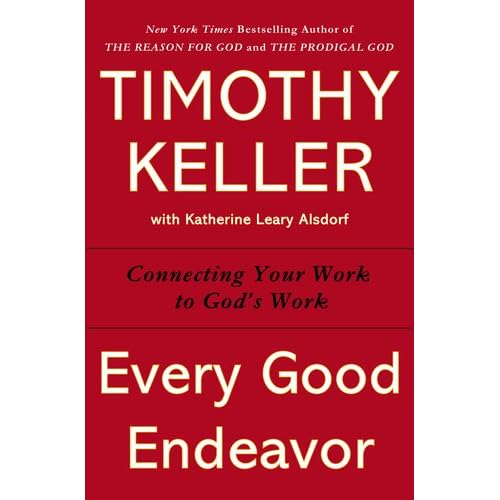
Dr. Timothy Keller book: Every Good Endeavor

There’s a deep disconnect between the lives of many church members and many pastors. I don’t think it’s wrong for a man to go from high school straight to college, and from there straight to seminary only to wind up leading a church with very little work experience outside the church. Many of the men who have done so have become very good pastors.

But church members have careers, jobs, vocations, occupations, or whatever you want to call what they do with the majority of their working time, away from anything remotely related to the church. Men especially tend to identify with their work. If they identify with their work and their work is not related to church, then they experience that disconnect I mentioned. Church is something they visit once or twice a week. “Real life” isn’t church.

I’m not sure most pastors have a clue. As long as they see people in the pews everything seems okay, that is until that person falls into some sort of sin. When that happens the pastor is left baffled as to how this person could have turned without realizing that this person has a more significant identity outside of the church.

Dr. Timothy Keller has made some inroads into this mysterious area of church life with a new book Every Good Endeavor: Connecting Your Work to God’s Work.

Based on short biographical sketches, Keller seems to be one of those who doesn’t have much of a work history outside the church. Having not read the book, I don’t know if he covers everything well, but he gave an interview to Desiring God where he discusses some of the points in his book. If this is any indication, then he seems to handle the theology very well and accurately assesses the impact of culture on our working world.

God's Work and Ours: And Interview with Timothy Keller

Based on this interview it’s probably worth reading on those aspect alone. I plan to get hold of this book and read it. It might be worth your while as well.

Saturday, July 21, 2012

Calling All Pastors

I’ve heard time and time again about the special call to be a pastor. Different denominations or churches have their checklists to determine if someone has that special calling. Almost all agree that someone needs to feel the call such that one cannot help but to preach the gospel.

To be honest, it bothers me. The reason is because I don’t see that pattern in the Bible as something normative where something else is taught in scripture as normative. That, and I’ve seen too many pastors who I’m sure met the items on the checklist and felt that great call to be a pastor who had no business in a pulpit.

Disclaimer: this isn’t intended as an in-depth look at all the passages in the Bible related to this, but more of a summary of a few items I’ve noticed with a reference to the teaching of the Bible in general. I can do specifics, but I’ll spend all my time typing up every little thing and lose the few people who read this in the first few chapters.

First of all, when the Bible talks about a “calling”, it always refers to salvation. So any calling applies to all Christians. The calling to be a pastor is no more special or pertinent than it is to all Christians to fulfill their purpose in the Kingdom of God. The pattern of the Roman Catholic Church was that priests and other clergy were held in high regard as ministers as opposed to the masses of Christians who were not called into ministry. To a large degree, this mindset has carried into the Protestant churches despite the principles of the Reformation to the contrary.

As much as men fit for being pastors are encouraged to follow that calling, all Christians must be taught that each of us have a ministry that requires no less of a commitment to fulfill. Seminaries have typically been set up as Pastor-making schools, but there needs to be ministerial education for all Christians.

Second of all, Paul talks about his great desire to preach the gospel. I may be wrong, but I think many people look at this as normative for pastors (but not for anyone else). Paul nowhere indicates that this is normative for anyone in ministry other than himself. He nowhere mentions Timothy’s great desire to preach the gospel. He simply charged Timothy in his role as a pastor.

Jesus’ call of Peter was not according to his strongly feeling called. If Peter felt anything, it was an inclination to deny him when death was on the line. Jesus’ commission of Peter had more to do with Peter’s submission to the truth of the gospel than a special feeling.

For myself, I’ve never felt called to be a pastor. I am the pastor of my family and it’s my responsibility to see to their spiritual development. I take that mantle with more commitment than the professional pastor of a church. Churches have people leave and join all the time. How many pastors go looking for the people on the rolls who never attend? By I desperately don’t want my wife and children to consider themselves members of some other family. They happen to be my family and my charge.

But as for the pastor of a church, I’ve never considered my gifts to be strong in all the areas where today’s pastors are expected to excel. If God made it clear that I was the man who needed to assume the role of the pastor of a church, I expect he would give me all the tools I need to accomplish what he had for me to do there.

But that’s the point I’m getting at here. God gives pastors. It’s not on account of some emotional investment, but on a steadfast commitment to fulfill the role that God entrusts to us. And it’s the same for everyone – not just pastors.