Showing posts with label Philosophy. Show all posts

Saturday, May 17, 2014

Is God In Time?

If you want a good radio program to listen to each week, you should listen to Greg Koukl’s program
produced by Stand to Reason. He addresses some of the current events from the standpoint of a Christian apologist and he is always thought-provoking.

It’s trite say that I don’t always agree with him on everything. However, it’s of a matter that I disagree with him that I want to address. This episode can be accessed here.
  
Click on the link at the bottom of the short article listing what topics he discussed to download and listen to the program. In the list, caller #3 brought up a topic about whether or not God is in time. Greg’s response is that he is in time. To support this assertion, he asked a question: “Does God count?” If you answer no, then you must affirm that there is something that God cannot do. This appears to contradict the omnipotent nature of God. If you answer yes, then counting requires time for that kind of sequential reasoning. The caller was stumped by the question at least for the duration of the call and Greg used the lack of response from the caller to elaborate on his point somewhat.

I know a little bit about time. I majored in physics and particularly excelled in special relativity. I also studied philosophy later on. From that perspective, I can say that philosophical considerations of time are burdened by the generalization of the flow of time as experienced macroscopically. That is to say that all of us as human beings living on the surface of planet Earth experience the flow of time in a generally uniform way. We make exceptions for time zones and the perception of time due to situational circumstances, but when an hour passes for me, it can be said that an hour passes for everyone else. When we think of a long time, we might think of a span of years out our lifetime, or even centuries or eons of history. As long as time has always passed the same as it has now, our imaginations can do a pretty good job of providing an accurate assessment of what happened. When we think of time, that’s what we think of.

So is God in time? Answering that question requires that we have an accurate concept of time. While the concept of time that I mentioned above is not entirely inaccurate and typically helpful in carrying out our everyday lives, it’s not helpful in addressing whether God is in time or not.

So we need to answer another question first: Is there a more refined understanding of time that we can know? The short answer is yes. The long answer involves discussing what that understanding is and how it pertains to the question of whether God is in time or not.

First of all, this understanding has not always been known. The implication is that this understanding is not important for having faith in God or understanding what is important about him. Previous generations didn’t need this understanding. The scriptures don’t go into detail about this although there is enough information to hint at the refined information while using normal experience to convey God’s relationship to a fallen creation as Creator, Provider, Redeemer, etc. We can know THAT God is involved with the world without understanding HOW God is involved with the world.

What we know about time is brought to us by testable and observable science. Now science cannot give us knowledge with absolute certainty. It can only give us knowledge that has a likelihood of being true based on a set of predetermined criteria. That which is testable and observable, like devising carefully planned laboratory experiments to test hypotheses, yields the highest likelihoods. That which is observable but not testable, like the social habits of gorillas in the wild, yields a high level of likelihood if conclusions are restricted only to what is observed. Many scientists make speculations based on non-testable observations or employ non-observable assumptions in the initial conditions of their experiments and call it observational science. Things like global warming or the age of the universe fall into this category. The likelihood of these speculative conclusions cannot be determined. Therefore we assign terminology such as “educated guess” or “professional assessment” to these kinds of speculations. The conclusion of someone trained in a field is reasonably more likely to be right about something than someone not trained in that field. However, I will reiterate, we have no way of measuring such rightness. In other words, we have no way of knowing for sure.

There is one other area of knowledge that we can use. This is theoretical science. Theoretical science uses the conclusions of testable science to develop either untestable conclusions or testable hypotheses. When a theoretical scientist adds a single element of speculation, (s)he crosses the line into speculative science. As long as theoretical calculations remain based solely on testable conclusions, the likelihood of the theory being true is fairly high. The knowledge of time that I will explore here relies exclusively on testable and theoretical science.

Parenthetically, as materialism is not provable, I am not given to it. It is assumed that the material world will behave in predictable ways. Otherwise, testable science is irrational. However, the material world can still behave in predictable ways while there is yet more to reality than the material world. During anomalous events where something other than the material world affects the material world, even testable science is unreliable. This is not germane to this discussion and I won’t discuss the ramifications here, but it bears mentioning in any discussion of testable knowledge.

From testable science, we know that time is affected by relative motion. The faster something goes relative to something else the greater the differential between their respective temporal frames of reference. That is if you saw a clock speed up to close to the speed of light, you would observe that the time on the clock slows down relative to the watch on your own wrist. There’s a paradox that will bake your noodle, to quote a popular movie: that is that if someone else were traveling with the clock, they would observe your watch moving more slowly than the clock they were with. Now, in one respect, this is merely an observational effect. That is to say that you both are actually experiencing the same passage of time, but the light from each of you takes longer to get to the other because of the change in distance.


However, there is an actual differential in the passage of time. In a famous experiment, synchronized atomic clocks were sent on flights in different directions. When they were brought back together, the time between them was different. Another observation was made in the engineering of the cathode ray tube. This tube was the display device that made the first television technology possible and has been used until the recent advent of LED, plasma, etc screens. An in the tube and electron gun is used to fire electrons onto a screen where pixels would be illuminated by the electrons. In order to aim the electrons at different pixels on the screen they would be fired through a magnetic field that would change their direction. The field had to be calibrated precisely. The engineers at first calibrated the field according to a uniform passage of time. However, it wouldn’t work. The electrons weren’t going where they were supposed to. They discovered Einstein’s theory of relativity and applied a transformation formula to account for a difference in temporal frame of reference between the moving electron and the stationary tube apparatus. It worked and has worked since. Therefore, some differential in time must be in play.

And it makes sense. It has been tested and observed that the speed of light is the same regardless of the difference in movement between the source of light and the measuring apparatus. This has become a governing principle of special relativity. That is to say that if you were in a car with the headlights on and you approached the speed of light driving forward, light would not build up in front of the car as you continually caught up with the light emitted from the headlights. As far as you could observe, light would continually move away from you at the speed of light. For an observer standing on the side of the road in the distance, light would reach them from the car at the speed of light, not at the speed of light plus the speed of the car. The only way to account for the constant speed of light is to adjust the passage of time for car and stationary observer. Time would pass more slowly for the car than the observer.

Now, this is difficult to think on in macroscopic terms because we simply don’t experience such dramatic speeds. But on a subatomic level, these speeds are normal. The movement of a subatomic particle is the energy that it has. If it absorbs energy and increases to a level of motion that approaches the speed of light it will appear to the particles surrounding it as though it slows down, or looses energy. Given the laws of thermodynamics, the energy cannot be lost in a system, which includes a single temporal frame of reference. So what happens to the energy? This question, in particular, pertains to electrons that whiz around the atomic nucleus with alarming speed. When energy of some sort is absorbed the by electron, it increases in speed such that it appears to lose energy relative to the rest of the atom. With the loss in energy, it drops to a lower orbital shell and emits a photon of light perpendicular to the plane of centripetal movement. The photon travels for a time according to the distance between the atom of origin and the particle the photon hits. The energy of the atom is absorbed by the receiving particle.
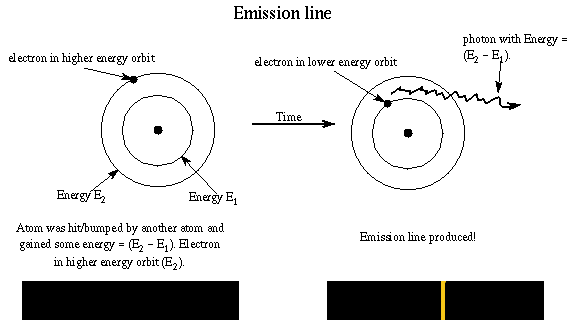
To theorize from the perspective of the frame of reference of the electron, the distance between the electron and the particle that its lost energy is transferred to is nullified. There is no photon to the electron. There is only the receiving particle. The photon is like an accountant that equalizes the difference between extremely diverse temporal frames of reference. In fact, the same formula that describes the difference between temporal frames of reference can also be used to describe the difference in distance between temporal frames of reference. At this point, time and distance become interchangeable.

This effect is extremely common. The light hitting your eyes as you read this is following this same course. The radio signals that you use in your wifi, your cell phone, and countless other devices in this world, are using photons of electromagnetic radiation that follow this same pattern of temporal accounting. There are so many particles of electromagnetic radiation crisscrossing your body at any given moment, that your experience of time is a tapestry of temporal extremes homogenized into a single macroscopic temporal experience. This is such an astonishing thing to consider that scientists have speculated that there is only one electron in the universe and shares its existence throughout all things by virtue of its extreme temporal experience.

In fact, on the most foundational level of matter, the difference between matter and energy becomes interchangeable. Energy, therefore, is a material thing. This is how we were able to develop atomic energy by converting matter directly to energy. At this point, matter doesn’t consist of a tangible substance as we would understand it, but it consists of form itself. For my non-materialist brothers and sisters, it consists of the very thought of God.

And so time and distance are part and parcel of the matter and energy contained within them. You cannot have time and distance without matter and energy. You cannot have matter and energy without time and distance.

I have written all that to arrive at this final conclusion. If God is immaterial, he cannot be in time. At the very least, he cannot be in time as we know it.

So what do we make of Greg Koukl’s argument in the form of the question, “Does God count?” There is a theological statement in the Bible that bears considering: “In the beginning, God created the heavens and the earth.” While many theologians don’t consider God as Creator to be an attribute of God, I do. While creation adds nothing to him, I believe the very fact of creation to be absolute. As such, God as Creator is an absolute attribute. He creates because he is creative. And creation bears his attributes in many different ways so as to glorify him. He magnifies himself in creation. Creation doesn’t materially exist on its own, but every particle of matter and energy with the smallest iteration of time and distance is upheld by the mind of God. God doesn’t count in order to know. God counts in order to create, and what he creates is temporal. If this is true, Greg’s question refutes his implications. God’s counting is the source of temporal creation, not the result of it.


I hope you were able to follow along this far to the end of a longer article than I like to read, much less write. But I hope it has been well worth it for you.

Wednesday, March 5, 2014

A Mistaken View of Love

Dr. William Lane Craig’s recent podcast entitled “A Mistaken View of Love” can be found here. Please listen to it. I used the same title here because while he answers a mistaken view of love, he does so while himself holding a mistaken view of love.

The mistaken view of love that he addresses is summed up in the statement, “Love is not a feeling; love is a decision.”

The idea that he counters with is that a full and mature love will involve affection. He points out that “the Bible affirms that God has genuine compassion.” Instead of supporting this by citing where the Bible says this, however, he points out the etymology of the English word, “compassion”. He says that the word means to “have feeling with the other person; to be connected with that other person emotionally.” He says that instead of “saying that love is not an emotion, maybe what we should be saying is love is not merely an emotion.”

He, of course, attributes the mistaken view of love he is answering to Calvinists, legalists, and Muslims. This may be the case with Muslims. The category of legalism is too broad to pin something like this on. There are legalistic charismatics or semi-pelagians, for example. His idea of Calvinism is that a fully sovereign God is too harsh a concept. It goes to show that he doesn’t fully understand Calvinism.

But perhaps he has God’s impassibility in mind. This is a disputed doctrine, even among Calvinists, that essentially says that God is not motivated by passion. That is to say that God doesn’t experience emotion like his creatures do. This excludes, obviously, the incarnated Son of God in his humanity. The Bible typically anthropomorphizes God. In descriptions of God, we see that he has hands, eyes, a heart, a face, wings like a hen, breath, etc. Descriptions of emotion attributed to God are likewise probably anthropomorphisms as well.

The reason I say that is because we know today that emotions involve physical functions. We are walking chemical factories producing hormones and endorphins that generate emotional states that were created to drive appropriate actions. Because of the fall, our emotional states are often inappropriate for specific situations. When we are wronged, for example, a heightened anxiety level may produce anger that if acted upon will cause us to fail to be gracious. While fear of social repercussions may drive us to refrain from acting inappropriately on this anger, the proper way is to deny the emotion based on a desire for God and his will to be done over and against our own will. Because we are in an inappropriate state of emotion, this must be disimpassioned. It is rather trust in God’s steadfast love over and against passion that allows us to behave lovingly for others.

So in some respect love is a decision in that acting in love often requires a decision. But I also agree with Craig that it is more than a decision. In a perfect world, it will involve appropriate emotional responses. But this isn’t a perfect world. So what is love and what is its relationship to emotion?

Let me discuss emotion first. It’s a woefully vague word that typically lacks nuance. When we use the word, we typically think of our own personal experience with emotion. Since our emotions are temporal, we typically don’t have the capacity to feel all emotions simultaneously. When we feel a couple of competing emotions at the same time we are often left confused and befuddled. But our experience with emotions is that we are both motivated by them and wrestle against the way inappropriate ones would motivate us to behave. God doesn’t have this problem because isn’t motivated by temporal emotions. Emotions in some limited way, however, are a picture of some of God’s attributes. While God is not motivated by emotions, he is motivated by his attributes. But all of his attributes are eternally unified. That means that God loves and hates all at once; that he is merciful and wrathful all at once; that he is gracious and just all at once. It’s hard for us to understand the fullness of this truth because we possess fallen, limited minds.

And so the love of God is no mere emotion. All of his other attributes are wrapped up in it; All of them. So it’s reasonable that he is impassable. That brings me to the definition of love. It isn’t a decision, although it results in decisions over and against wayward emotions. It isn’t an emotion because it can be wielded most effectively when not motivated by some emotional attachment. Jesus talked about this in Matthew 5:

“You have heard that it was said, ‘You shall love your neighbor and hate your enemy.’ But I say to you, Love your enemies and pray for those who persecute you, so that you may be sons of your Father who is in heaven. For he makes his sun rise on the evil and on the good, and sends rain on the just and on the unjust. For if you love those who love you, what reward do you have? Do not even the tax collectors do the same? And if you greet only your brothers, what more are you doing than others? Do not even the Gentiles do the same? You therefore must be perfect, as your heavenly Father is perfect. (Matthew 5:43-48, ESV)

So loving when we lack an emotional motive for doing so is likened here to “being perfect as our heavenly Father is perfect.” Chew on that for a while.

But it still doesn’t fully define love. The famous John 3:16 hints at the definition:

“For God so loved the world, that he gave his only Son, that whoever believes in him should not perish but have eternal life. (John 3:16, ESV)

God’s love involves the giving of his Son. How did he give his Son? As a sacrifice. Love involves sacrifice. Paul admonishes husbands in Ephesians 5 to “love your wives, and Christ loved the church and gave himself up for her…” How did Christ give himself up for the church? He died on the cross as a sacrifice to atone for her sins. Husbands are called to love their wives by living sacrificially for them. But John came out with a clear statement about love in John 15:

Greater love has no one than this, that someone lay down his life for his friends. (John 15:13, ESV)

So love necessarily involves sacrifice. But here we also see that that sacrifice is not for oneself, but that it is for someone else. I like the way my pastor phrases it. He defines love as seeking someone else’s best interest above your own. This definition of love is far deeper than the decision to sacrifice for someone or that it will involve some emotional attachment. It goes against the idea that we should compete against others so that we can be winners while everyone else is losers. It means that we should be willing to lose so that someone else can “win”; that they can receive all the benefit. And it means that we will do that for our enemies as well. Tough love is used to refer to being hard on someone because you know it is good for them. True love is tougher because it requires us to be hard on ourselves because it’s good for someone who doesn’t deserve a good thing.

And none of us are capable of doing that without living in the power of Christ who did that for us.

Friday, February 21, 2014

Teleological Value in the Kingdom of Heaven

“To be significant to God is to be significant in the most ultimate sense. No greater personal significance can be imagined.” –Wayne Grudem

This kind of significance is ontological. This is the value that we have simply because of who God made us to be. Two different ontologies can be understood in this. The first one is that all people are made in the image of God. That makes all of us intrinsically valuable for no other reason than we are his image bearers. The second is that some are his chosen people. These were the ancient Hebrews, and some still consider the Jews of today as their descendants to be God’s chosen people. But according to the Apostles of Christ, all those who have faith in Christ are God’s chosen people, his “elect”. By truly having faith in Christ, additional ontological value is added by virtue of the regeneration and indwelling of the Holy Spirit. The elect share a special relationship with God beyond simply being human.

But people also have teleological value. In one sense, teleological value is related to ontological value. In another sense, it is an independent value.

The teleological value of people can most easily be seen to be independent of their ontological value. Pharaoh was not ontologically one of God’s chosen people, but he was teleological instrumental in carrying out God’s plan to secure the identity of the Hebrews as his chosen people as a nation of underdogs. In their low position among the Egyptians, there was no way they could secure their freedom alone, much less assume possession of Canaan, without divine assistance. God used Pharaoh’s burdensome rule over the Hebrew slaves to create an apparent impossibility that served as a backdrop for the glory of God in the signs and wonders. So even someone of no faith in God can be used mightily to glorify him.

The link between ontological value and teleological value in the Kingdom of Heaven can be seen throughout the New Testament. I’ll  point to one passage. 1 Corinthians 12 and 14 both discuss teleology in the Body of Christ. In the middle of this discussion, in chapter 13, Paul brings up the ontology of the believer in sharing the relationship between members of the Trinity as Jesus taught in John 14. So the way we work together as the Body of Christ (teleology) is related to the relationship we have with God (ontology). The way this works is that the spiritual gifts each have been given are to employed with that same ontological relationship (love).

But even the way the ontological relationship is applied to employing the gifts is ontological. That is, it can be applied more or less faithfully. That’s the reason for Chapter 13 in the larger discussion. Paul’s admonition was to apply our ontological value as faithfully as possible.

But remember that teleology is also independent of ontology. Faithful application of ontology doesn't guarantee greater teleological value. That is, it doesn't mean that we will be more useful. Unfaithful application of ontology doesn't mean that we will be less useful. Many believers who unfaithfully apply their ontological value turn out to be quite useful in the body of Christ and many believers who apply their ontological value turn out to not be very useful at all. Nevertheless, Paul admonishes all of us to seek the greater gifts. That is, as we apply our ontological value faithfully we should also seek greater teleological value.

But God will use who he wants as he chooses, and that is good. For example, an older man I know has been creatively unemployed for years. He has used his time wisely to do such things as breed cattle and do contract finish carpentry. More importantly, he is involved in our local Child Evangelism Fellowship as a Shepherd and Teacher, he serves as a mentor for troubled teens in the community, and he helps out with a local ministry to at-risk children in the poorest neighborhoods in town. He is gifted only with a love of God and a desire to help kids know Jesus. He’s in the hospital on a long recovery after a severe automobile accident during a recent ice storm. He’s been taken out of the game for a while. He can barely move or speak. Once possessing great teleological value, that value is now on hold. If you have read thus far, you must know that few people will… read this far at least. You might acknowledge that I have a gift of understanding things that is at least exotic if not exceptional. But you might recognize that I don’t have a great ability to hold an audience such as to impart this understanding very effectively. I took one of those Spiritual gifts inventories and came up with the gift of knowledge, but not so much the gift of teaching. I certainly don’t have a gift of ministering to children effectively in any way. I write articles like this because frankly I don’t have anything better to do. This is one way of using this gift even though I know it won’t be very useful to anyone. So the man I know who isn't well gifted is teleologically more valuable that I am although I am apparently more gifted in some way. There’s no way I could take this man’s place in his absence. So while we are to pursue the greater gifts, even that doesn't necessarily influence our teleological value.

Now the message is often geared toward most people who either don’t apply their ontological value faithfully or don’t pursue the greater gifts. But the message also is given that we each have gifts that are useful. That teaching isn't in the text anywhere. Some gifts as given to some people are virtually useless. How many people die never having fulfilled their full potential? And yet God has given them gifts that were not used. We should try our best to steward our gifts and to be teleological valuable, that is, useful. But we are not promised to be successful, only that the attempt is required. Paul explains that different members have different functions, but that some should receive a higher honor.

Therefore, as we earnestly desire the greater gifts and faithfully apply our ontological value, we can only find contentment in our ontological value despite seeking satisfaction our faithful stewardship. Do not confuse your teleological value with your ontological value and rest in God whether you turn out to be very useful or not.

Tuesday, November 26, 2013

If Postmodernism is True...


If postmodernism is true, then I can't know what they believe.

If postmodernism is true, then they can't know what to deconstruct.

If postmodernism is true, then why do they even write books?

If postmodernism is true, then how do they know that I don't understand them?

Since I know what postmodernists believe, they seem to be clear on what they are deconstructing, they write books propagating their absurdity, and they think they know that I don't understand them, then we know a few things:

  • Postmodernism is false.
  • Postmodernists are justifying untruths that they want to be true or denying truths they don't want to be true. (Since postmodern deconstruction seems aimed at ethical considerations, squirming out of moral obligations is almost certainly the purpose of postmodernism.)
  • The opposite of naturalistic, evidential science (which is rationalistic) isn't supernaturalism (which is also rationalistic), it's postmodernism (which intends to deconstruct rationalism).
Watch this panel discussion to see Christian philosophers Sarah Geis, Larry Burtoft, Doug Groothuis, and David Mathewson deconstruct postmodernism.

Sunday, September 29, 2013

Understanding the Bible More Deeply

What are your expectations for this article? What do you think you will discover that I have written? It probably is not what you expect. If you expect something, then you have some idea what I have written before you have read it.

Likewise, if you have read the Bible a hundred times, or even just once, you will have some idea of what to expect if you read it again. Nevertheless, you will undoubtedly find something you didn’t notice the first time you read it.

But understanding the Bible more deeply doesn’t involve simply finding information you didn’t remember from reading it before as you read through it again. While that is part of it, there are some additional principles that are helpful for enhancing how you gain a deeper understanding.

First, reading the Bible over and over again is additive. It’s like pouring coffee back in the coffee maker and brewing it over and over again. It will get stronger each time you brew it.

Second, as you read, you will want to investigate information in passages that you didn’t investigate before that helps you understand the passage better.

Third, as you learn about what the Bible says, you must read it as though what it says is true. That means it will influence your philosophy and desires. This colors what you read and frames it the way the Author of the Bible intended instead of what you intended the times you read it previously.

Fourthly, as your mind and heart change, your ability to think in the terms of the Bible will change. I’ve discussed this before as categories. The greater your intelligence, the greater your ability to apprehend these different categories.

Finally, your understanding will increase as you put into action what you learn from the Bible.

I will write in more detail on these in future articles, but I wanted to introduce this series to you beforehand. While I will be writing in more general terms, I do want to make known that what has instigated this is a desire to counter a tendency for people to engage the Bible on a more superficial level. Particular strains of this are as follows:

  • Many people fear all theological debate as somehow unnecessary. Some theological debate is indeed unnecessary. However, there is plenty of deadly theological error that goes unchallenged because people won’t internalize convictions that counter rank heresy. If God truly saves people, some theological battles are important lest people unwittingly engender a lack of faith.
  • There are people who believe that some things cannot be understood because they cannot understand them. There may be some things that we cannot understand, but I assure you that we can understand far more than many of us think. Where even great theologians have chalked some things up to “mystery”, many of these mysteries are understandable because God has revealed them to us and has given us the Holy Spirit to help us understand what the Bible says.
  • People are sinful and simply don’t wish to learn what they are doing wrong so they can repent of it. On one level, they know what the truth is, but they cloak their eyes as though they don’t see it and either convince themselves that it isn’t true or isn’t understandable.
  • People have a cultural sensibility or hold some popular philosophy that is challenged by the scriptures. They determine to understand what the Bible says only up to the point where it disagrees with their deeply-held unbiblical beliefs.

These patterns of misunderstanding the Bible are deadly to the Church because many of these kinds of people are otherwise faithful church members. Many people pray for a revival. The only way it will come about is if these patterns of unbelief are challenged and changed by a movement of the Holy Spirit in the hearts of Christians. That’s why I’m presenting this series.

Monday, September 2, 2013

Hiding Place: Deliverance from Sin or a Prison

Linda
Years ago I was friends with an elderly lady who sang baritone with me in the choir at one of the base chapels at Camp Lejune, NC. Her name was Linda. She died over a decade ago.

Linda’s parents were German musicians who were killed in a train accident just before WWII. Linda spent the next few years in a Catholic school in Berlin during the war. She would take bread to the French prisoners of war.

She invited me to a thanksgiving dinner one year where she had some Austrian friends from the old country coming to visit. The dinner was lovely and I enjoyed the cultural experience. After her friends left, Linda sat down with me and told me of the old days. She told me how she saw the propaganda of the Third Reich and how deeply it influenced her thinking. She also told me how wrong it all was, but how hard she struggled against her indoctrination. She told me how she knew it was wrong to hate Jews, but that she wrestled with her training as a young child to hate them.

She told me other things as well about how brutal some of the Allies were, particularly the Russians. She told me how she came to America and took speech lessons to remove the German accent, How she married and remarried. How evil her second husband was and how he was spending time in Leavenworth prison. Even colonels with spotless records can commit crimes. She told me of her hidden son who lived, yet as little more than a spectre, after a serious automobile accident cause by his use of drugs.

In all of this, she left the Roman Catholic Church and found solace in the gospel of grace. A military wife, she stayed close to the base and the transient families she knew there.

Her story is an echo of many. I’ve been fascinated with how such deceit as what was propagated by the Nazis can affect entire populations of people. Last night I watched a documentary following the children and grandchildren of Hitler’s top men as they fought against the dark legacy of their infamous fathers. It reminds me of the warnings in Exodus where the iniquity of the fathers will be visited on their children and grandchildren. Although their descendents did not commit the crimes of their fathers, they bear the weight of guilt among those who survived their father’s sins.

I’ve also watched Lore recently. It’s a German movie about children of Nazi parents who fled across country to their grandmother’s house when their parents were taken prisoner in the Allies’ invasion of Germany. Many of the reviewers noted that the kids acted like brats. Frankly, they aren’t any worse than the kids Hollywood portrays. It’s odd that we are quick to judge Nazi kids while giving the kids on, say, Home Alone, a pass.

(Note: Being a foreign film, Lore isn’t rated. It should be rated R. There are adult themes and images. Beware if you plan to watch this.)

But I compare this also to the 2009 portrayal of the Diary of Anne Frank. My favorite portrayal was the 1980 version. After watching this one, I see how filtered the 1980 version was. The 2009 version showed a bit more the bratty side of Anne Frank. Are victims less sinful than their murderers?

On the one hand, we would note that a murderer committed a crime. It is no crime to be victimized. However, the nature that rises up to fuel a murderer is shared by all people. We are all products of a fallen world and subject to the dubious information that colors it darkly. It is perhaps more apparent to those with murderous parents, such as the offspring of Himmler, Goering and Goeth. They are more able to recognize the evil in their own hearts because of the astonishing sins of their fathers because of the difficulty in coming to terms with sins they did not commit. For that matter, think of the Jews born in captivity during the exile in Babylon and Persia. They didn’t commit the sins that sent their parents into exile, yet they must bear the burden of those sins.

For others, who have lived in relative peace by parents who are relatively decent people, sin seems to be more of an abstract thing. In this case, fairness becomes the arbiter of sin. It is easy to believe that which is fair is good and that which is unfair is evil. It is easy to arrive at the conclusion that being fair makes one a sinless person.

So it is hard for such people to understand that God is not fair. Jesus, the only truly innocent man, paid the price for the sins of evil people. That’s not fair. It can only be fully understood by people who truly see the depths of their own sin, whether that sin has resulted in action or harbored only in the mist of dark thoughts and desires.

Linda knew the sin she was capable of and fought against it while all around her swarmed the stench and decay of death in the sins of others. Let us not treat slavery to righteousness as a prison when we are hidden from our destruction as Anne Frank and her family was for a time. Let us regard our hideaway in Christ soberly and not despise it. Let us not be brats in the Body of Christ.

5. I acknowledged my sin to you,
and I did not cover my iniquity;
I said, “I will confess my transgressions to the Lord,”
and you forgave the iniquity of my sin. Selah
6. Therefore let everyone who is godly
offer prayer to you at a time when you may be found;
surely in the rush of great waters,
they shall not reach him.
7. You are a hiding place for me;
you preserve me from trouble;
you surround me with shouts of deliverance. Selah (Psalm 32:5-7, ESV)

Tuesday, July 23, 2013

Is Love Powerful?


In watching a video of Ken Meyers delivering a keynote address at Hope College, he quotes literary and social critic, Marion Montgomery, as saying, “The opposite of love is not hate. The opposite of love is power.” (HT: Justin Taylor)

Quotes like this in their brevity require a bit of interpretation. On the surface, this idea seems curious. What did Marion Montgomery mean by this? I’m not very familiar with Marion Montgomery. Is he a Christian? A quick glance at Wikipedia indicates that he was perhaps Roman Catholic. How faithful he was to that is anyone’s guess. I suspect that most people who would read this don’t have a clue.

So we first contemplate the most reasonable possible meaning of this statement by asking the question: In what ways is power antithetical to love? Perhaps Montgomery was thinking about the tendency of people to seek power over other people in the ordering of lives for the sake of enhancing the quality of their own life at the expense of the quality of another’s life. Given the Montgomery was a social critic, this makes sense. Perhaps one could draw some distinction between this kind of power-seeking and hatred, although the two overlap in some ways.

Does this make sense theologically? Jesus told the disciples in Mark 10:42ff that rulers of the Gentiles lord it over people, but that it should not be so among them. The idea of power-hunger is in some significant way not the way leadership should be carried out among Christians. This seems reasonable.

Now there are Christians who think this way fundamentally. If we love God, we should submit to him. That is, our love for God is to give up power over ourselves. But they apply the same thinking to God. Since god loves us, he’s a “gentleman”. That is, he doesn’t try to control us. If the opposite of love is power, then God cannot be both loving and all-powerful.

The problem is that this is not what the Bible teaches. Not only is God loving and all-powerful, he is love and power.

Now the observation that people who are hungry for power are sinfully hateful in doing so does not negate that power used righteously is loving. Think of a person who lacks the ability to care for himself. It is loving for someone who is able to exert power over that person in order to seek the best interest of the one who is incapable.

This concept plays into the debate over Reformed theology. Those who oppose it say that man is capable of choosing Christ on his own. Therefore, it is not loving for God to exhibit power over men. Those who are Reformed in their thinking say that man in incapable of choosing Christ on his own. Therefore, it is loving for God to use his power to give him the ability to make that choice.

There are more refined nuances that I won’t go into regarding different strains of Reformed thinking. However, I will note that if Montgomery were steeped in Catholic thinking, this would comport with the idea that power is the opposite of love.

We all have some power over other people. Just by saying hello or ignoring someone on the street has some effect on the people we encounter. Actions that are truly loving in nature are powerful. My fellow Christians, let us conduct ourselves in such a way as to convey the love of Christ that people will be warmed to his message. That we can give the gift of the Holy Spirit who raised Christ from the dead and can resurrect the souls of those we meet.

That’s the power of love.

Wednesday, July 3, 2013

Finding True Love In Your Marriage

Mike Leake graciously asked if I would write a guest article to be posted on his site, which I was more than happy to do. The article is entitled "Love in the Trinity" and introduces the basis for a lesson I plan to teach at Equipping University Wednesday night at 6:30 at Western Avenue Baptist Church. That lesson will be entitled "Finding True Love In Your Marriage". If you are looking for true love in your marriage and are in the vicinity of Statesville, NC, come in and learn what it's all about.

Thursday, May 16, 2013

From Star Trek "Into Darkness" to God's Revelation: Into Light

I’m watching a special on the History Channel that’s investigating physics from observations of the latest Star Trek movie. One statement was made that I think relates to understanding God. One of the contributing physicists made the comment that we don’t know why time dilation exists. This isn’t entirely true. He didn’t qualify this comment, but let me investigate it briefly and then turn to what this means for understanding God.

The speed of light is the speed limit of the universe despite theoretical speculations of warp fields and wormholes. The reason why is related to the production of electromagnetic radiation, aka “light”. Light doesn’t have mass. We can say that light transfers energy. More accurately, it is a pattern of energy manifest in multiple spacetime frames of reference. I’ll keep it as simple as possible:

Energy is transferred from particle of matter to particle of matter when those particles come close enough for their respective systems of forces to influence each other significantly. When a photon of light is produced, the particle that produced it approaches the speed f light and suddenly loses energy. That energy is transferred to the object the photon eventually strikes. As the particle that produced the photon approaches the speed of light in the process, the distance between it and the object that will eventually absorb the photon that is produced is diminished infinitely within the frame of reference of the originating particle. This is called distance contraction and is part and parcel of time dilation. So as far as the source particle is concerned, it hits the receiving particle and thus loses energy.

To the outside observer, no distance ever closed in. What happened is that time dilated for the originating particle and distance contracted. Once the energy transfer happened, the distance snapped back to “normal” and its temporal frame of reference became relatively aligned once again with its surrounding objects. But the distance contraction is represented to the outside observer as a photon and the observation of the originating particle hitting the receiving particle is represented as a difference of time related to the distance. This is the speed of light.

The reason we have time dilation is more easily thought about with a simple thought experiment. If Bonnie and Clyde drive by in their automobile and fire a gun down the road, the velocity of the bullet relative to Bonnie and Clyde is roughly the same as if the vehicle were not in motion. To someone standing by the side of the road, the bullet whizzes by at the velocity of the bullet if the vehicle were not in motion plus the velocity of the vehicle.

But light is different. If it were night time and Bonnie and Clyde had their headlights on, the velocity of the photons being emitted from the front of the vehicle would be precisely the speed of light. To the observer on the side of the road, the velocity of the photons would also be precisely the speed of light. So what happened to the speed of the vehicle? That’s where time dilation comes into play. There is a time differential between the vehicle and the observer on the side of the road that accounts for the difference due to the velocity of the car. That’s time dilation.

Now add to this that a vast spectrum of electromagnetic radiation is passing around us constantly in all directions. We perceive a relatively uniform temporal frame of reference. However, it is anything but uniform. On the subatomic level, time is extremely volatile and changing. If it weren’t, we wouldn’t be able to perceive anything around us. The chemical processes that make our bodies work couldn’t happen. We wouldn’t be able to see the world around us. There would be no life.

Where to go from here? I could talk about creation and how this applies to developing cosmologies. I could talk about how this isn’t often applied very well when people consider the various speculations regarding the beginnings of the universe. But I want to make another observation regarding God’s revelation of himself.

What I’ve written above in very simple and short order is understood by very few people, including some physicists who are interviewed by TV shows. The reason is that most people find it acceptable to relate to and survive in the world with the mere macroscopic perceptions available to us. Most people couldn’t tell you how a simple radio works, but they know how to use one.

God revealed himself to us in a very practical way. In this way, even many intellectually challenged people can grasp the basics about God. However, the depth of information included is enough to make the brightest among us wrestle with some of the issues he revealed to us. Most people are able to function quite well with the information God has provided although some concepts are difficult and present apparently conflicting concepts.

The fact is, God knows the range of intelligence of the creatures that bear his image and planned on giving us all enough to warrant a knowing faith as well as keep us learning about him for a lifetime. The Great Commission is more than simply leading someone into the Kingdom. The Great Commission is more than simply teaching a new believer the basics. We are all to be disciples until we pass from this world.

Thursday, April 18, 2013

What Is Free Will According to the Bible?

The issue of free will is a common topic of thought that influences so much of how we perceive the world. In Christian circles, it delineates how we understand God’s sovereignty. The relationship between God’s sovereignty and man’s will may not be immediately evident if you’ve never thought about it, but when the different views are investigated, it’s not man’s will that is primarily at stake, but God’s sovereignty.

The two general views I will be discussing loosely be referred to as “synergism” held by “synergists” and “monergism” held by “monergists”. Other terms are often used for either view, but these more closely describe their differences.

  1. Synergists hold that God created man with a free will that God has no control at all over. This doesn’t speak to how God has no control over man’s will. Synergists vary widely on their explanations here and I won’t discuss those here. Essentially, for man to be saved, God does his part and man does his part.
  2. Monergists hold that God created man with a free will that is limited by God’s will. For man to be saved, God does all of it including giving faith to the man. With the faith that God has given, man therefore freely chooses God.


Systems of Categories

To properly understand the issue, we need to clarify the differences in categories. Because of cultural sensibilities in the West, most people categorize willful actions into two mutually exclusive categories:

a. Things God controls.

b. Things man controls.
This is the basic understanding of synergists.

The question then arises whether this categorical system is understood and employed by the Biblical authors. Paul, writing to Jews and Greeks alike in his letter to the Romans, understands that some may use this system. In chapter 9 he anticipates the question, “Why does he still find fault? For who can resist his will?” But his answer is to imply a different system of categorization: “But who are you, O man, to answer back to God?”

Paul had already discussed this other system of categorization in Romans 6. There he indicates that we are either in bondage to sin or in bondage to righteousness. There is no middle of the road. He indicates that we will either desire sin or desire God’s will when he says in verse 17 that “you who were once slaves of sin have become obedient from the heart to the standard of teaching to which you were committed.” Even still, he recognizes that cultural philosophies will make it difficult for many to understand when he says in verse 19, “I am speaking in human terms, because of your natural limitations.”

He also teaches this to the Corinthians in the second letter we have to them. In chapter 4 Paul writes in verse 7 that “the surpassing power belongs to God and not to us.” The verses that follow spell out the nature of what this means. But the previous verse tells us something else about how the will of man and God’s will differ:

‘For God, who said, “Let light shine out of darkness,” has shown in our hearts to give the light of knowledge of the glory of God in the face of Jesus Christ.’

Some synergists contend that this means that God brings us up to the point where we can choose freely, indicating that we could choose to deny God at this point. I would disagree saying that this is a description of what Paul indicates in Rom 12:3. However, I want to point out something else that both side should agree with in this verse: God’s will is creative and man’s will is reactive. In other words God’s will creates what God desires by the sheer power of God. Man can create nothing. Rather, we make choices that are before us based on factors that are entirely within God’s creative order. God’s will creates. Our will reacts to creation. There is nothing above God that hinders him in any way.

But perhaps our best example is Jesus Christ. Both God and man, he has a will that is both creative and reactive. This is why he told the disciples in John 6 that he came “not to do my own will, but of the will of [the father].” Therefore, we are to use a different system of categorization than the one above:
a. God’s will

b. Man’s will

This is the basic understanding of monergists.

On the surface, this looks like a different way of writing the same categories. However, they indeed are different. In the first set, man controls things that God does not. The set of things that man controls are subject to his decisions. Following God is not in the set of things that God controls. In the second set of categorizations, man can either choose to do God’s will or to do his own will. If it is God’s will that he chooses to do God’s will, then even that is God’s will. Man’s will is anything that does not agree with God’s will. So if we do Man’s will, we are in bondage to sin. If we do God’s will, we are in bondage to righteousness and free from sin.

The mistake in most debates is to conflate these two systems. You can’t impose one system on the other and expect to have a reasonable debate. The reason is because the method of God’s influence is confused. Synergists will incorrectly interpret monergism as indicating that God manipulates his people like puppets. This is an incorrect understanding of the second system. Monergists may incorrectly interpret the first system as indicating that synergists don’t truly believe that God is sovereign. 


The Fundamental Difference

However, Monergists aren’t far off base. What synergists do in order to claim God as sovereign is to modify their definition of sovereignty. Many of them hold definitions that are within the pale of Christian orthodoxy, so they should be well accepted as brothers and sisters in Christ.

What I do note is that synergists actually hold to some limitations on the free will of man. For example, who would say, if asked, that men can make decisions that are not before them to make. Can I decide to buy a blue car if only a green one or a red one is available? No. That decision is not before me. Can I decide to create a new universe that does not exist? No. I don’t have that power. I can perhaps imagine another universe to some small degree, but actually creating one is outside of my will. Can I make a decision that belongs to someone else? To be sure, people try to do this. They influence public opinion with propaganda or try to manipulate the factors that influence a person’s decision. However, none of us has the power to directly make a decision for someone else. We have limits on our will.

So, synergists should agree that man’s will is limited. Monergists already hold this openly. The difference is merely one of degree.

What is truly different is that monergists place no limit whatsoever on the sovereignty of God. Synergists must. If man is to have things that he controls that God does not, then God must not have control over those things. That’s a limitation on his sovereignty. So the question of free will is really no so much about the will of man, although it is to a degree; it’s really about the sovereignty of God. 


Monergistic Method of Free Will

For the Synergists out there who might chance to read this, you may be wondering how it is that monergists believe that God gives free will, limited as it is, and yet remains completely sovereign over all things. I will explain what it is that monergists generally believe.

There are two areas of influence that God takes with people. Everyone is influenced by his created order. No one makes any decision or choice that isn’t contingent on God’s created order. God doesn’t directly influence decisions, but the free will of man flows out of what is to us an extremely complex set of physical and spiritual factors. Remember that I said that God’s will is creative and man’s will is reactive.

But there’s another factor that only some people have. God himself indwells some people. That doesn’t mean that God is directly making the decisions for the people he indwells. Rather, he guides, like a father, those he indwells. He holds back information until his people are mature enough to handle that information. They can use the information they obtain as they grow in their understanding of God to make decisions. What God creates in them is not a compulsory faith, but a faith of life. Indwelling his children has made them alive so that they are no longer in bondage to sin, but free from sin and in bondage to righteousness. That means that they have a desire for God. What God gives his children in the regenerating life of the Holy Spirit is a desire for God that they absolutely did not have before.

That’s how God influences his children. As such, I will testify that my will is not my own, but my desire, like Christ, is to do the will of my Father in heaven.


To God be the Glory!

Tuesday, April 16, 2013

When Being Wrong is Okay (For the Time Being)

One thing that is often pointed out by non-Christians is how Christians have so many different interpretations of the Bible. First of all, such observations usually lack the recognition that we agree on so much. Second of all, such observations fail to take into account that Christians typically recognize that understanding comes over a period of time for Christians.

The law of noncontradiction is true. That is, something is not what it is not. Regarding beliefs, some people forget this simple law of logic and want to claim that truth values are relative to individuals. The reason is because they want to believe what they want to believe without being scrutinized for it based on some larger discoverable objective truth. But the law of noncontradiction indicates that where we have more than one person who believes mutually exclusive things, only one of them can be right (and possibly none of them are).

The only conclusion is that most of us wrong about something, and are certainly ignorant about many things. The Bible takes this into consideration. There are certain core things we need to get right and we have the testimony of God’s revelation as well as the indwelling of the Holy Spirit to guide us. Because of the guilt of our sin, we cannot bear to understand the truth fully. Knowing this, the Holy Spirit of God guides us gently, revealing things as we are able to handle them.

This is why Paul tells us not to violate the conscience of people who believe that we should not eat meat that has been sacrificed to idols (1 Cor 8). Who is right? Should people be allowed to eat meat sacrificed to idols or should they abstain? Read the passage. I won’t go into it here. But I will make these observations:

  1. People abstained from eating meat sacrificed to idols because they worshipped those idols before they understood the truth of Christ and partaking of that meat was a burden to their consciences. However, not everyone had that problem. So, we are allowed to be wrong in ways that benefit us.
  2. However, we are still wrong. God doesn’t want to leave us there. He wants us to grow in our understanding. That means putting of childish things as Paul also tells the Corinthians in chapter 13. So this cannot be used as an excuse to believe whatsoever anyone wants.
  3. Therefore, we need to be humble to the fact that we need to improve our understanding. We cannot have pride in the belief that we have it all figured out or to deny that there is any understanding that is greater than what we currently understand. If a donkey can inform Balaam, then God can use anyone to enlighten us.

Saturday, February 2, 2013

The Problem With Knowing There Is No God


Steve Hays posted a link on Triablogue to a book reviewon the Denver Seminary site for James Spiegel’s The Making of an Atheist.

After reading the review, I had an observation and realized that there was an epistemological problem with atheistic naturalism:


I've always said that I don't believe in atheists. I don't think they exist, despite anyone's profession to be one.
In a world where too many Christians are too afraid to point out what the Bible clearly says about disbelief, I appreciate Spiegel's Biblical observation that unbelief is rooted in a desire to self-justify personal sin.

Aside from this, I've just checked around because I've never thought of this before, but it occurred to me that atheism has no positive arguments. A quick web search of "positive arguments for atheism" led to some sites that claim to have positive arguments, but they were anything but positive. All the arguments I see have to with disproving God. That would seem obvious given the label "a-theist" except that if it were possible for this universe to exist without God, there must be an epistemology that someone could verbalize for it that doesn't include a reference to something that doesn't exist.

The best argument I found so far is that naturalism predicts the universe... except that it doesn't. The argument doesn't prove a lack of God. It merely assumes that the universe functions in a predictable way and further assumes that it follows that if the universe is predictable that God could not exist (which is also begging the question of a negative argument and therefore employs two healthy fallacies).

But this only demonstrates that if there is no God we wouldn't be able to know it since our ability to know anything is bound up in what is naturally predictable. If there is a God, then the only way we could know it is if he reveals himself to us in a way that is naturally unpredictable (miraculous) - which he has.