Showing posts with label Theology. Show all posts

Saturday, May 17, 2014

Is God In Time?

If you want a good radio program to listen to each week, you should listen to Greg Koukl’s program
produced by Stand to Reason. He addresses some of the current events from the standpoint of a Christian apologist and he is always thought-provoking.

It’s trite say that I don’t always agree with him on everything. However, it’s of a matter that I disagree with him that I want to address. This episode can be accessed here.
  
Click on the link at the bottom of the short article listing what topics he discussed to download and listen to the program. In the list, caller #3 brought up a topic about whether or not God is in time. Greg’s response is that he is in time. To support this assertion, he asked a question: “Does God count?” If you answer no, then you must affirm that there is something that God cannot do. This appears to contradict the omnipotent nature of God. If you answer yes, then counting requires time for that kind of sequential reasoning. The caller was stumped by the question at least for the duration of the call and Greg used the lack of response from the caller to elaborate on his point somewhat.

I know a little bit about time. I majored in physics and particularly excelled in special relativity. I also studied philosophy later on. From that perspective, I can say that philosophical considerations of time are burdened by the generalization of the flow of time as experienced macroscopically. That is to say that all of us as human beings living on the surface of planet Earth experience the flow of time in a generally uniform way. We make exceptions for time zones and the perception of time due to situational circumstances, but when an hour passes for me, it can be said that an hour passes for everyone else. When we think of a long time, we might think of a span of years out our lifetime, or even centuries or eons of history. As long as time has always passed the same as it has now, our imaginations can do a pretty good job of providing an accurate assessment of what happened. When we think of time, that’s what we think of.

So is God in time? Answering that question requires that we have an accurate concept of time. While the concept of time that I mentioned above is not entirely inaccurate and typically helpful in carrying out our everyday lives, it’s not helpful in addressing whether God is in time or not.

So we need to answer another question first: Is there a more refined understanding of time that we can know? The short answer is yes. The long answer involves discussing what that understanding is and how it pertains to the question of whether God is in time or not.

First of all, this understanding has not always been known. The implication is that this understanding is not important for having faith in God or understanding what is important about him. Previous generations didn’t need this understanding. The scriptures don’t go into detail about this although there is enough information to hint at the refined information while using normal experience to convey God’s relationship to a fallen creation as Creator, Provider, Redeemer, etc. We can know THAT God is involved with the world without understanding HOW God is involved with the world.

What we know about time is brought to us by testable and observable science. Now science cannot give us knowledge with absolute certainty. It can only give us knowledge that has a likelihood of being true based on a set of predetermined criteria. That which is testable and observable, like devising carefully planned laboratory experiments to test hypotheses, yields the highest likelihoods. That which is observable but not testable, like the social habits of gorillas in the wild, yields a high level of likelihood if conclusions are restricted only to what is observed. Many scientists make speculations based on non-testable observations or employ non-observable assumptions in the initial conditions of their experiments and call it observational science. Things like global warming or the age of the universe fall into this category. The likelihood of these speculative conclusions cannot be determined. Therefore we assign terminology such as “educated guess” or “professional assessment” to these kinds of speculations. The conclusion of someone trained in a field is reasonably more likely to be right about something than someone not trained in that field. However, I will reiterate, we have no way of measuring such rightness. In other words, we have no way of knowing for sure.

There is one other area of knowledge that we can use. This is theoretical science. Theoretical science uses the conclusions of testable science to develop either untestable conclusions or testable hypotheses. When a theoretical scientist adds a single element of speculation, (s)he crosses the line into speculative science. As long as theoretical calculations remain based solely on testable conclusions, the likelihood of the theory being true is fairly high. The knowledge of time that I will explore here relies exclusively on testable and theoretical science.

Parenthetically, as materialism is not provable, I am not given to it. It is assumed that the material world will behave in predictable ways. Otherwise, testable science is irrational. However, the material world can still behave in predictable ways while there is yet more to reality than the material world. During anomalous events where something other than the material world affects the material world, even testable science is unreliable. This is not germane to this discussion and I won’t discuss the ramifications here, but it bears mentioning in any discussion of testable knowledge.

From testable science, we know that time is affected by relative motion. The faster something goes relative to something else the greater the differential between their respective temporal frames of reference. That is if you saw a clock speed up to close to the speed of light, you would observe that the time on the clock slows down relative to the watch on your own wrist. There’s a paradox that will bake your noodle, to quote a popular movie: that is that if someone else were traveling with the clock, they would observe your watch moving more slowly than the clock they were with. Now, in one respect, this is merely an observational effect. That is to say that you both are actually experiencing the same passage of time, but the light from each of you takes longer to get to the other because of the change in distance.


However, there is an actual differential in the passage of time. In a famous experiment, synchronized atomic clocks were sent on flights in different directions. When they were brought back together, the time between them was different. Another observation was made in the engineering of the cathode ray tube. This tube was the display device that made the first television technology possible and has been used until the recent advent of LED, plasma, etc screens. An in the tube and electron gun is used to fire electrons onto a screen where pixels would be illuminated by the electrons. In order to aim the electrons at different pixels on the screen they would be fired through a magnetic field that would change their direction. The field had to be calibrated precisely. The engineers at first calibrated the field according to a uniform passage of time. However, it wouldn’t work. The electrons weren’t going where they were supposed to. They discovered Einstein’s theory of relativity and applied a transformation formula to account for a difference in temporal frame of reference between the moving electron and the stationary tube apparatus. It worked and has worked since. Therefore, some differential in time must be in play.

And it makes sense. It has been tested and observed that the speed of light is the same regardless of the difference in movement between the source of light and the measuring apparatus. This has become a governing principle of special relativity. That is to say that if you were in a car with the headlights on and you approached the speed of light driving forward, light would not build up in front of the car as you continually caught up with the light emitted from the headlights. As far as you could observe, light would continually move away from you at the speed of light. For an observer standing on the side of the road in the distance, light would reach them from the car at the speed of light, not at the speed of light plus the speed of the car. The only way to account for the constant speed of light is to adjust the passage of time for car and stationary observer. Time would pass more slowly for the car than the observer.

Now, this is difficult to think on in macroscopic terms because we simply don’t experience such dramatic speeds. But on a subatomic level, these speeds are normal. The movement of a subatomic particle is the energy that it has. If it absorbs energy and increases to a level of motion that approaches the speed of light it will appear to the particles surrounding it as though it slows down, or looses energy. Given the laws of thermodynamics, the energy cannot be lost in a system, which includes a single temporal frame of reference. So what happens to the energy? This question, in particular, pertains to electrons that whiz around the atomic nucleus with alarming speed. When energy of some sort is absorbed the by electron, it increases in speed such that it appears to lose energy relative to the rest of the atom. With the loss in energy, it drops to a lower orbital shell and emits a photon of light perpendicular to the plane of centripetal movement. The photon travels for a time according to the distance between the atom of origin and the particle the photon hits. The energy of the atom is absorbed by the receiving particle.
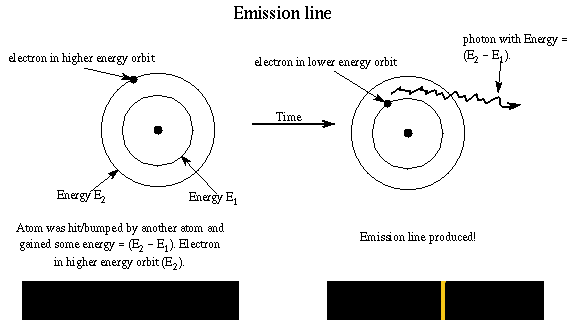
To theorize from the perspective of the frame of reference of the electron, the distance between the electron and the particle that its lost energy is transferred to is nullified. There is no photon to the electron. There is only the receiving particle. The photon is like an accountant that equalizes the difference between extremely diverse temporal frames of reference. In fact, the same formula that describes the difference between temporal frames of reference can also be used to describe the difference in distance between temporal frames of reference. At this point, time and distance become interchangeable.

This effect is extremely common. The light hitting your eyes as you read this is following this same course. The radio signals that you use in your wifi, your cell phone, and countless other devices in this world, are using photons of electromagnetic radiation that follow this same pattern of temporal accounting. There are so many particles of electromagnetic radiation crisscrossing your body at any given moment, that your experience of time is a tapestry of temporal extremes homogenized into a single macroscopic temporal experience. This is such an astonishing thing to consider that scientists have speculated that there is only one electron in the universe and shares its existence throughout all things by virtue of its extreme temporal experience.

In fact, on the most foundational level of matter, the difference between matter and energy becomes interchangeable. Energy, therefore, is a material thing. This is how we were able to develop atomic energy by converting matter directly to energy. At this point, matter doesn’t consist of a tangible substance as we would understand it, but it consists of form itself. For my non-materialist brothers and sisters, it consists of the very thought of God.

And so time and distance are part and parcel of the matter and energy contained within them. You cannot have time and distance without matter and energy. You cannot have matter and energy without time and distance.

I have written all that to arrive at this final conclusion. If God is immaterial, he cannot be in time. At the very least, he cannot be in time as we know it.

So what do we make of Greg Koukl’s argument in the form of the question, “Does God count?” There is a theological statement in the Bible that bears considering: “In the beginning, God created the heavens and the earth.” While many theologians don’t consider God as Creator to be an attribute of God, I do. While creation adds nothing to him, I believe the very fact of creation to be absolute. As such, God as Creator is an absolute attribute. He creates because he is creative. And creation bears his attributes in many different ways so as to glorify him. He magnifies himself in creation. Creation doesn’t materially exist on its own, but every particle of matter and energy with the smallest iteration of time and distance is upheld by the mind of God. God doesn’t count in order to know. God counts in order to create, and what he creates is temporal. If this is true, Greg’s question refutes his implications. God’s counting is the source of temporal creation, not the result of it.


I hope you were able to follow along this far to the end of a longer article than I like to read, much less write. But I hope it has been well worth it for you.

Wednesday, March 5, 2014

A Mistaken View of Love

Dr. William Lane Craig’s recent podcast entitled “A Mistaken View of Love” can be found here. Please listen to it. I used the same title here because while he answers a mistaken view of love, he does so while himself holding a mistaken view of love.

The mistaken view of love that he addresses is summed up in the statement, “Love is not a feeling; love is a decision.”

The idea that he counters with is that a full and mature love will involve affection. He points out that “the Bible affirms that God has genuine compassion.” Instead of supporting this by citing where the Bible says this, however, he points out the etymology of the English word, “compassion”. He says that the word means to “have feeling with the other person; to be connected with that other person emotionally.” He says that instead of “saying that love is not an emotion, maybe what we should be saying is love is not merely an emotion.”

He, of course, attributes the mistaken view of love he is answering to Calvinists, legalists, and Muslims. This may be the case with Muslims. The category of legalism is too broad to pin something like this on. There are legalistic charismatics or semi-pelagians, for example. His idea of Calvinism is that a fully sovereign God is too harsh a concept. It goes to show that he doesn’t fully understand Calvinism.

But perhaps he has God’s impassibility in mind. This is a disputed doctrine, even among Calvinists, that essentially says that God is not motivated by passion. That is to say that God doesn’t experience emotion like his creatures do. This excludes, obviously, the incarnated Son of God in his humanity. The Bible typically anthropomorphizes God. In descriptions of God, we see that he has hands, eyes, a heart, a face, wings like a hen, breath, etc. Descriptions of emotion attributed to God are likewise probably anthropomorphisms as well.

The reason I say that is because we know today that emotions involve physical functions. We are walking chemical factories producing hormones and endorphins that generate emotional states that were created to drive appropriate actions. Because of the fall, our emotional states are often inappropriate for specific situations. When we are wronged, for example, a heightened anxiety level may produce anger that if acted upon will cause us to fail to be gracious. While fear of social repercussions may drive us to refrain from acting inappropriately on this anger, the proper way is to deny the emotion based on a desire for God and his will to be done over and against our own will. Because we are in an inappropriate state of emotion, this must be disimpassioned. It is rather trust in God’s steadfast love over and against passion that allows us to behave lovingly for others.

So in some respect love is a decision in that acting in love often requires a decision. But I also agree with Craig that it is more than a decision. In a perfect world, it will involve appropriate emotional responses. But this isn’t a perfect world. So what is love and what is its relationship to emotion?

Let me discuss emotion first. It’s a woefully vague word that typically lacks nuance. When we use the word, we typically think of our own personal experience with emotion. Since our emotions are temporal, we typically don’t have the capacity to feel all emotions simultaneously. When we feel a couple of competing emotions at the same time we are often left confused and befuddled. But our experience with emotions is that we are both motivated by them and wrestle against the way inappropriate ones would motivate us to behave. God doesn’t have this problem because isn’t motivated by temporal emotions. Emotions in some limited way, however, are a picture of some of God’s attributes. While God is not motivated by emotions, he is motivated by his attributes. But all of his attributes are eternally unified. That means that God loves and hates all at once; that he is merciful and wrathful all at once; that he is gracious and just all at once. It’s hard for us to understand the fullness of this truth because we possess fallen, limited minds.

And so the love of God is no mere emotion. All of his other attributes are wrapped up in it; All of them. So it’s reasonable that he is impassable. That brings me to the definition of love. It isn’t a decision, although it results in decisions over and against wayward emotions. It isn’t an emotion because it can be wielded most effectively when not motivated by some emotional attachment. Jesus talked about this in Matthew 5:

“You have heard that it was said, ‘You shall love your neighbor and hate your enemy.’ But I say to you, Love your enemies and pray for those who persecute you, so that you may be sons of your Father who is in heaven. For he makes his sun rise on the evil and on the good, and sends rain on the just and on the unjust. For if you love those who love you, what reward do you have? Do not even the tax collectors do the same? And if you greet only your brothers, what more are you doing than others? Do not even the Gentiles do the same? You therefore must be perfect, as your heavenly Father is perfect. (Matthew 5:43-48, ESV)

So loving when we lack an emotional motive for doing so is likened here to “being perfect as our heavenly Father is perfect.” Chew on that for a while.

But it still doesn’t fully define love. The famous John 3:16 hints at the definition:

“For God so loved the world, that he gave his only Son, that whoever believes in him should not perish but have eternal life. (John 3:16, ESV)

God’s love involves the giving of his Son. How did he give his Son? As a sacrifice. Love involves sacrifice. Paul admonishes husbands in Ephesians 5 to “love your wives, and Christ loved the church and gave himself up for her…” How did Christ give himself up for the church? He died on the cross as a sacrifice to atone for her sins. Husbands are called to love their wives by living sacrificially for them. But John came out with a clear statement about love in John 15:

Greater love has no one than this, that someone lay down his life for his friends. (John 15:13, ESV)

So love necessarily involves sacrifice. But here we also see that that sacrifice is not for oneself, but that it is for someone else. I like the way my pastor phrases it. He defines love as seeking someone else’s best interest above your own. This definition of love is far deeper than the decision to sacrifice for someone or that it will involve some emotional attachment. It goes against the idea that we should compete against others so that we can be winners while everyone else is losers. It means that we should be willing to lose so that someone else can “win”; that they can receive all the benefit. And it means that we will do that for our enemies as well. Tough love is used to refer to being hard on someone because you know it is good for them. True love is tougher because it requires us to be hard on ourselves because it’s good for someone who doesn’t deserve a good thing.

And none of us are capable of doing that without living in the power of Christ who did that for us.

Friday, February 21, 2014

Teleological Value in the Kingdom of Heaven

“To be significant to God is to be significant in the most ultimate sense. No greater personal significance can be imagined.” –Wayne Grudem

This kind of significance is ontological. This is the value that we have simply because of who God made us to be. Two different ontologies can be understood in this. The first one is that all people are made in the image of God. That makes all of us intrinsically valuable for no other reason than we are his image bearers. The second is that some are his chosen people. These were the ancient Hebrews, and some still consider the Jews of today as their descendants to be God’s chosen people. But according to the Apostles of Christ, all those who have faith in Christ are God’s chosen people, his “elect”. By truly having faith in Christ, additional ontological value is added by virtue of the regeneration and indwelling of the Holy Spirit. The elect share a special relationship with God beyond simply being human.

But people also have teleological value. In one sense, teleological value is related to ontological value. In another sense, it is an independent value.

The teleological value of people can most easily be seen to be independent of their ontological value. Pharaoh was not ontologically one of God’s chosen people, but he was teleological instrumental in carrying out God’s plan to secure the identity of the Hebrews as his chosen people as a nation of underdogs. In their low position among the Egyptians, there was no way they could secure their freedom alone, much less assume possession of Canaan, without divine assistance. God used Pharaoh’s burdensome rule over the Hebrew slaves to create an apparent impossibility that served as a backdrop for the glory of God in the signs and wonders. So even someone of no faith in God can be used mightily to glorify him.

The link between ontological value and teleological value in the Kingdom of Heaven can be seen throughout the New Testament. I’ll  point to one passage. 1 Corinthians 12 and 14 both discuss teleology in the Body of Christ. In the middle of this discussion, in chapter 13, Paul brings up the ontology of the believer in sharing the relationship between members of the Trinity as Jesus taught in John 14. So the way we work together as the Body of Christ (teleology) is related to the relationship we have with God (ontology). The way this works is that the spiritual gifts each have been given are to employed with that same ontological relationship (love).

But even the way the ontological relationship is applied to employing the gifts is ontological. That is, it can be applied more or less faithfully. That’s the reason for Chapter 13 in the larger discussion. Paul’s admonition was to apply our ontological value as faithfully as possible.

But remember that teleology is also independent of ontology. Faithful application of ontology doesn't guarantee greater teleological value. That is, it doesn't mean that we will be more useful. Unfaithful application of ontology doesn't mean that we will be less useful. Many believers who unfaithfully apply their ontological value turn out to be quite useful in the body of Christ and many believers who apply their ontological value turn out to not be very useful at all. Nevertheless, Paul admonishes all of us to seek the greater gifts. That is, as we apply our ontological value faithfully we should also seek greater teleological value.

But God will use who he wants as he chooses, and that is good. For example, an older man I know has been creatively unemployed for years. He has used his time wisely to do such things as breed cattle and do contract finish carpentry. More importantly, he is involved in our local Child Evangelism Fellowship as a Shepherd and Teacher, he serves as a mentor for troubled teens in the community, and he helps out with a local ministry to at-risk children in the poorest neighborhoods in town. He is gifted only with a love of God and a desire to help kids know Jesus. He’s in the hospital on a long recovery after a severe automobile accident during a recent ice storm. He’s been taken out of the game for a while. He can barely move or speak. Once possessing great teleological value, that value is now on hold. If you have read thus far, you must know that few people will… read this far at least. You might acknowledge that I have a gift of understanding things that is at least exotic if not exceptional. But you might recognize that I don’t have a great ability to hold an audience such as to impart this understanding very effectively. I took one of those Spiritual gifts inventories and came up with the gift of knowledge, but not so much the gift of teaching. I certainly don’t have a gift of ministering to children effectively in any way. I write articles like this because frankly I don’t have anything better to do. This is one way of using this gift even though I know it won’t be very useful to anyone. So the man I know who isn't well gifted is teleologically more valuable that I am although I am apparently more gifted in some way. There’s no way I could take this man’s place in his absence. So while we are to pursue the greater gifts, even that doesn't necessarily influence our teleological value.

Now the message is often geared toward most people who either don’t apply their ontological value faithfully or don’t pursue the greater gifts. But the message also is given that we each have gifts that are useful. That teaching isn't in the text anywhere. Some gifts as given to some people are virtually useless. How many people die never having fulfilled their full potential? And yet God has given them gifts that were not used. We should try our best to steward our gifts and to be teleological valuable, that is, useful. But we are not promised to be successful, only that the attempt is required. Paul explains that different members have different functions, but that some should receive a higher honor.

Therefore, as we earnestly desire the greater gifts and faithfully apply our ontological value, we can only find contentment in our ontological value despite seeking satisfaction our faithful stewardship. Do not confuse your teleological value with your ontological value and rest in God whether you turn out to be very useful or not.

Sunday, November 17, 2013

Glorifying God: Leveling the Cessationist / Continuationist Battlefield

This is an article that was introduced by this article and provides one of two examples for it.

I also want to mention that I won’t address every single issue relating to the larger theological debate, but to demonstrate how glorifying God opens the door for understanding his purpose in the theological tension.

There has been debate among Southern Baptists recently regarding the activity of the Holy Spirit among the people of God. In some ways this is a simpler debate than what I addressed in the previous article, but the tension is still there.

The core of the debate stems from a difference in the way we understand how God speaks to us. Continuationists point out that the Bible never directly says that the charismata (miraculous gifts) were supposed to cease. This is a fair observation. It’s also a similar argument non-Trinitarians make that the Bible never mentions the Trinity. However, since we see that the Bible still teaches the Trinity one aspect at a time, it is viable that the Bible could teach that the charismata have stopped. Nevertheless, it’s a somewhat more tenuous position than the Trinity. It’s only a degree of rationale removed from that used by Harold Camping, for example, to promote his unique (and now rather obviously incorrect) eschatology.

Nevertheless, Cessationists make this case. But their issue has an additional rationale that is related to how we know what is to be included in the canon of scripture. In other words, if God is causing people to speak in tongues that they don’t know or prophesy the future in such a way as to direct people what they are supposed to do, that means that we should have some material today that should be added to scripture. So there’s a presuppositional argument for making the connections in scripture that they do.

There is far more to the debate than this. To be fair, Continuationists don’t think that prophesy today should be included in scripture and Cessationists don’t think that all charismata have utterly ceased.

One big argument that Cessationists make is that Continuationists enable false claims. My first observation here is that it doesn’t falsify the Continuationists to point out their abuses. However, there should be no claim to charismata without serious discernment to ward of false claims.

That is where glorifying God comes in. False claims are exclusively a result of seeking to glorify the bearer of the alleged charismata (and, in the case of some professional charlatans, to line their pockets) rather than glorifying God.

How does this work out?

For Cessationists, legitimate charismata happen. Given that the goal of the Holy Spirit is to glorify Christ by revealing him to us, that is precisely what such charismata will do. Outside of this result, the charismata should be suspect. For Contiuationists, since the charismata will only result in glorifying Christ through leading us to his known revelation to us, much of what passes as charismata are not legitimate.

If our focus is turned upon the glory of our Lord, Jesus Christ, in his work on the cross and his divine sovereignty over us according to the revelation that we have by virtue of the same Holy Spirit who inspired it, then there is no debate. The false bearers of charismata should be duly rebuked by both Continuationists and Cessationists alike while legitimate charismata should be received with gratitude by both for pointing people to the true Christ of the Bible.

Saturday, November 16, 2013

Glorifying God: Leveling the Free Will / Election Battlefield

This is an article that was introduced by this article and provides one of two examples for it.

I also want to mention that I won’t address every single issue relating to the larger theological debate, but to demonstrate how glorifying God opens the door for understanding his purpose in the theological tension.

Many people are familiar with this old debate. The debate is an attempt to answer a very specific point of theological tension. That is, there are two truths taught in the Bible that appear to logically contradict one another. One truth is that God sovereignly elects his followers. That is to say that God chooses those who will follow him and acts to enable their faith. The other truth that is taught in scripture is that people are morally culpable for their sins. The contradiction is that if God is the one who chooses who will spend eternity with him, how can he hold the rest responsible for their sin since he didn’t give them the same opportunity? It seems to be a contradiction of fairness. It’s not fair that some people get paradise for all eternity and others have to suffer for all eternity if they have no say in where they are going.

There are a few approaches to answering this apparent contradiction:

Mitigate the doctrine of the sovereignty of God by saying that the Bible really doesn’t mean what it seems to mean when it indicates that God does the electing.
Try to explain the apparent contradiction philosophically. There are some philosophical principles implied in the Bible and some that we import unwittingly from the culture. Inasmuch as the philosophical principles align with the Bible, this isn’t a bad approach. When we import philosophy from outside the Bible, we usually end up with some error.
Acknowledge that each are true, but write off understanding them as an impossible task and miss the direction God intends for us to take.
Acknowledge that each are true and struggle to understand why God has revealed them to us. This is the option I pursue.

Fortunately, the Bible addresses this issue directly, although many in the first option camp earnestly interpret this passage differently. Paul, in his letter to the Romans (9:19ff), asks this very question. His answer, in the same way that God answered Job, is to appeal to the sovereignty of God. In other words, give God his glory.

So how does this work to level the battlefield?

The personal observation that we have is that we make decisions on our own. Whether this is entirely accurate remains to be seen. To keep this consideration simple, however, let’s make our decisions black and white: we have before us to choose to do good or to choose to do bad. If we choose to do good, by definition we choose to do God’s will. If we choose to do bad, then we choose to do our own will. If this is the case, then we have two different types of decisions we make: God’s will or our will.

Even the choosing must be categorized. If we choose to do God’s will, then our choice is according to the will of God. If we choose to do our will instead of God’s will, then the choosing is according to our will.

So if we do any good thing, we must give God the glory by not taking credit for it. If we do any bad thing, we must confess that we are sinners and assume the responsibility for our sin. Yet the confession is according to the will of God, for we are commanded to do this. And so by our confession, instead of bearing the responsibility for the sin, it is imputed to Christ who bore it on the cross.

What happens when we start with the glory of God and analyze the theological tension accordingly is that instead of a tension we find the purpose for the tension. The tension was only there in the first place because our audacious tendency to focus on ourselves. The issue isn’t whether we make one decision or another, but whether God is ultimately glorified. When we understand that this is the purpose for the tension in the first place and focus at last on the glory of God, the tension disappears and we receive the understanding of our Creator.

Friday, November 15, 2013

Glorifying God: Leveling the Theological Battlefield

I haven’t written much lately because I’m planning an extensive series on Christian epistemology. The term “epistemology” refers to how we answer the question “How do we know…?” I don’t intend merely to give a defense of the Bible. Rather, I intend to investigate how we know that the Bible is true, how we know our understanding of the Bible is true, and discover the presuppositions that undergird that investigation. This is an extensive study that links the nature of God and creation with his revelation to us. I also hope to make it accessible to the average reader. The hard part is to linearlize it so that I can make an index that organizes it so the relationships between different areas of thought and study can be understandable.

In many ways, this short series is related to that series. There is a link between the purpose of revelation and our ability to know what it means.

Let me ‘splain:

Theology matters. If you get God wrong, you end up worshipping the wrong God. There are two, even three, categories for analyzing the importance of theological doctrines. Dr. Al Mohler calls this Theological Triage. The difference between the first category and the other two is a matter of salvation. Doctrines that one must hold to be true in order to know one is saved are in the first category. All other doctrines are in the second and third categories.

There are many who would dispute finer points of what should be included in the first category and what should be included in the second and third categories. For example, orthodox Christians hold that the diety of Christ should be in the first category, but there are denominations that claim that Jesus is not God who would dispute that the deity of Christ belongs in the first category. Very liberal theologians might argue that the only thing in the first category is a claim to be a Christian. They would claim that one could even deny that there is a God at all (much less that he sent a Christ for any reason) and still be a Christian. As ridiculous as that all seems, it only goes to show that it’s important to make a case that theology matters.

There are those that tend toward liberal theology for the reason that we all just need to get along. They would say that glorifying God by getting along is better than actually knowing what god we are trying to glorify. Therefore, they intentionally ignore the fundamental differences between the One True God and the plethora of false imitations.

So thoughtful Christians debate the finer points of who God is by virtue of his special revelation to us in the Bible, through a particular denomination’s traditional interpretation, the general revelation of the created order, and our intellectual ability to sort it all out. Most people miss the fact that they have cultural blinders on when they theologize. With all this to muddy the waters, it’s no wonder that we wind up with theological differences as we try to reconcile apparent theological tension.

Some people even dismiss theological tension either by chalking it up as a divine mystery or claiming that there is no way that we can know. They say that we just have to accept it “by faith”. While it’s true that there are things about God that are unfathomable to us now, special revelation was given to us precisely so that we could know and understand what has been revealed.

I’ve largely been dissatisfied with the historic debates, even when I agree wholeheartedly with one side over another. First, they tend to focus on differences rather than similarities. Second, opposing categories of doctrinal thought are in opposition precisely because they hold different fundamentals in primacy over the rest.

It’s that second reason that I'm addressing in this article. So I’ll have two areas of theological debate to use as examples. And I will replace both with the fundamental that all things: revelation, the process of sanctification, the ordinances/sacraments of the Church, the fellowship of the Church, etc: all things exist to glorify God.

As this article is getting long so I’ll break the couple of examples into separate posts.

Sunday, September 29, 2013

Understanding the Bible More Deeply

What are your expectations for this article? What do you think you will discover that I have written? It probably is not what you expect. If you expect something, then you have some idea what I have written before you have read it.

Likewise, if you have read the Bible a hundred times, or even just once, you will have some idea of what to expect if you read it again. Nevertheless, you will undoubtedly find something you didn’t notice the first time you read it.

But understanding the Bible more deeply doesn’t involve simply finding information you didn’t remember from reading it before as you read through it again. While that is part of it, there are some additional principles that are helpful for enhancing how you gain a deeper understanding.

First, reading the Bible over and over again is additive. It’s like pouring coffee back in the coffee maker and brewing it over and over again. It will get stronger each time you brew it.

Second, as you read, you will want to investigate information in passages that you didn’t investigate before that helps you understand the passage better.

Third, as you learn about what the Bible says, you must read it as though what it says is true. That means it will influence your philosophy and desires. This colors what you read and frames it the way the Author of the Bible intended instead of what you intended the times you read it previously.

Fourthly, as your mind and heart change, your ability to think in the terms of the Bible will change. I’ve discussed this before as categories. The greater your intelligence, the greater your ability to apprehend these different categories.

Finally, your understanding will increase as you put into action what you learn from the Bible.

I will write in more detail on these in future articles, but I wanted to introduce this series to you beforehand. While I will be writing in more general terms, I do want to make known that what has instigated this is a desire to counter a tendency for people to engage the Bible on a more superficial level. Particular strains of this are as follows:

  • Many people fear all theological debate as somehow unnecessary. Some theological debate is indeed unnecessary. However, there is plenty of deadly theological error that goes unchallenged because people won’t internalize convictions that counter rank heresy. If God truly saves people, some theological battles are important lest people unwittingly engender a lack of faith.
  • There are people who believe that some things cannot be understood because they cannot understand them. There may be some things that we cannot understand, but I assure you that we can understand far more than many of us think. Where even great theologians have chalked some things up to “mystery”, many of these mysteries are understandable because God has revealed them to us and has given us the Holy Spirit to help us understand what the Bible says.
  • People are sinful and simply don’t wish to learn what they are doing wrong so they can repent of it. On one level, they know what the truth is, but they cloak their eyes as though they don’t see it and either convince themselves that it isn’t true or isn’t understandable.
  • People have a cultural sensibility or hold some popular philosophy that is challenged by the scriptures. They determine to understand what the Bible says only up to the point where it disagrees with their deeply-held unbiblical beliefs.

These patterns of misunderstanding the Bible are deadly to the Church because many of these kinds of people are otherwise faithful church members. Many people pray for a revival. The only way it will come about is if these patterns of unbelief are challenged and changed by a movement of the Holy Spirit in the hearts of Christians. That’s why I’m presenting this series.

Monday, September 23, 2013

Understanding the Bible More Deeply: Acting on the Bible

If you read the Bible as though it were true, you must act on what the Bible says.

Let’s say you purchase a new hair dryer. On the label is a warning not to use the hair dryer in water. I can’t imagine how anyone would use the hair dryer while they were taking a bath, for example. However, something happened to someone to warrant putting a warning label on hair dryers. So you read the label warning you not to use the hair dryer in water. You say, “Aha! It’s dangerous to use the hair dryer in water.” It doesn’t seem reasonable that you would then get in a bathtub full of water and try to dry your hair.

However, we too often do that with the Bible. We read what the Bible says, agree with its admonitions, and then promptly go out and do something other than what the Bible says. When that happens, we make it difficult to understand the Bible better because it would be detrimental. Isaiah, when faced with a vision of the living God in Isaiah 6:5 said, “Woe is me! For I am lost; for I am a man of unclean lips…” If too much were to be revealed to us at once, we would be undone. Isaiah came close.

As we act on the admonitions of scripture, we are strengthened to receive greater understanding by virtue of the Holy Spirit who indwells all believers. When we fail to act on the scriptures, our minds are cloaked by God, even those who are unbelievers, so that we don’t understand. Paul wrote this to the Romans in the first chapter of his letter to them:

"For the wrath of God is revealed from heaven against all ungodliness and unrighteousness of men, who by their unrighteousness suppress the truth. For what can be known about God is plain to them, because God has shown it to them. For his invisible attributes, namely, his eternal power and divine nature, have been clearly perceived, ever since the creation of the world, in the things that have been made. So they are without excuse. For although they knew God, they did not honor him as God or give thanks to him, but they became futile in their thinking, and their foolish hearts were darkened. Claiming to be wise, they became fools, and exchanged the glory of the immortal God for images resembling mortal man and birds and animals and creeping things...

“And since they did not see fit to acknowledge God, God gave them up to a debased mind to do what ought not to be done."

Therefore, although you have knowledge of all the God has revealed, disobedience will result in a failure to understand what you know.

Wednesday, September 18, 2013

Understanding the Bible More Deeply: Reading with a Changed Heart and Mind

This will take some explanation. As I stated in the previous article, none of us approaches the Bible as a blank slate. One way we do this is that each of us understands things by using systems of categorization. These systems also include rules for assigning things to each of these categorizations. Our systems of categorizations are learned from the things that are normal to us: our families, our friends, the media we give our attention to, the teachers we have, etc. Whenever I talk about “sensibilities”, this is typically what I mean.

Let me give you a simple example of what I mean by categorizations. Let’s say we have a bag of M&Ms. Can you think of some categories by which we can separate these M&Ms? The most obvious is by color. So we can separate them into piles of red, blue, green, orange, brown, etc.

But there may be another way of separating them. Now if the bag we have is just opened from the store, it probably only contains one kind of M&Ms, but if not, then there may be different kids mixed in. What I’m talking about is the difference between plain, the ones with nuts in them, or the ones with pretzels in them. Those are different categories than colors.

Are there any other kind of categories? Imagine the factory where M&Ms are made. They make M&Ms by some kind of lot number, I presume. That’s a category that few people think about. Or I would assume that there are some kind of quality control standards. Hopefully all M&Ms are in the category of those M&Ms that will pass inspection. But realistically, there are probably a few that do not pass inspection. Each quality standard is a different category against which each M&M must be tested. Each will either be in the category “pass” or the category “fail”.

But we don’t usually think about those categories. Nevertheless, it is a very important category for M&Ms. If you want the quality of M&Ms that you are used to, you should hope that each bag that you purchase has only M&Ms that are in the “pass” category of each quality standard.

But it’s the same way with the Bible. We approach the Bible at first with the most obvious sets of categories. As we read the Bible, we might pick up on the fact that there are sets of categories for examining our lives and thinking about God that we have never thought of before.

Too many theological debates are a result of different theologians using different sets of categories for understanding the Bible. All theological debates will be cleared up when God brings each of us to understand the set of categories we should have been using all along. When investigating different views, it is a sign of theological maturity that we are able to identify the sets of categories theologians use. When this happens, we can easily understand why theologians often debate so.

Identifying a theologian’s system of categories is also important for discerning the truth of a matter. Too many theologians are disingenuous. Such discernment allows us to see a theologian’s internal deception.

But also, as we develop Biblical systems of categories, our understanding of the Bible will deepen. So as you read, look for ways of thinking about things according to how they are presented in the Bible in ways that you haven’t previously considered.

Monday, September 16, 2013

Understanding the Bible More Deeply: Reading As Though It Were True

None of us approaches the Bible as a blank slate. On one end of the spectrum, some of us have a set of beliefs that we are intent on holding as true no matter what evidence is given to us to the contrary. On the other end of the spectrum are those who are willing to ditch their beliefs for any new thought that comes their way.

There is a balance between these that we can term “cautiously open” to changing our thinking. The question is on what basis we are cautiously open:

We might be cautiously open because we want to believe anything that will make us the most comfortable. Some atheistic naturalists like to accuse theists of merely fulfilling some evolutionary need to believe in a higher power. The fact is that we all have some need to feel good about ourselves and our lives.

We might be cautiously open because we want to justify some lack of moral culpability. We just want to sin and we don’t like anything or anyone telling us that our particular sin is immoral. If anything tells us we can commit that sin, we are willing to believe it. If anything tells us that we cannot commit a particular sin we are willing to deny it.

We might be cautiously open because we want power over other people. Like or not, these kinds of people exist in this world. They are willing to propagate beliefs among others that will enslave them ideologically and are willing to stifle beliefs that will free them ideologically. Most people are not very good at this. Some people are exceptionally good at this.

Parenthetically, we proclaim a gospel that sets people free from sin without denying that things clearly are sinful. It’s no wonder that some oppose this message with both the contention that something is not a sin and the good news that we can be free from it.

But the way we are to be cautiously open to changing our beliefs is if we desire truth and are willing to accept that we might not currently know the truth as fully as we can. This begs the question that the Bible is an accurate source of truth. The key to knowing is if we are honest about our sinful motives. If we are, then even a cursory reading of the Bible is sufficient for demonstrating that it is more honest about our own motives than we are. Peter testifies as much when he answers Jesus in John 6:68, “Lord, to whom shall we go? You have the words of eternal life.” The Samaritan woman that Jesus met at the well testified in John 4:29, “Come, see a man who told me all that I ever did.” This is the same reaction that we find in ourselves when we read the Bible and are honest about our own sinful motives.

Therefore, we cannot understand the Bible accurately if we do not read it as though it were true.

Thursday, September 5, 2013

Understanding the Bible More Deeply: Investigation

As I pointed out in the last article, the Bible wasn’t written in our cultural context. It was written by and to a people long ago with a different culture. They had different practices and routines, different political situations, and different popular philosophies. No doubt as we read the Bible we will encounter many references to things that are unfamiliar to us.

Also, as I pointed out in the previous article, reading the Bible over and over will result in noticing things we didn’t notice before. In early readings of the Bible, we will have a tendency to skip over things that we don’t recognize when they appear in the midst of things we do recognize. As we read through the Bible, it is likely that new things will strike us as something we need to investigate in order to understand the passage better.

Fortunately, we are blessed in these days to have rich resources for investigating these kinds of things. There are Bible handbooks, Bible dictionaries, commentaries, etc. I recommend checking more than one. Different aspects of information might be available in the work of different scholars.

Don’t be alarmed if you find that they don’t agree. You will be able to get a fuller view of uncertainty in scholarship that way. If the observation is related to a theological point of view, you will be able to see why something either supports or undermines your own point of view and you will be able to refine your thinking.

So you grow more deeply in your understanding as you gain more information on what you are reading. You also grow more deeply in your understanding as your own previous beliefs are challenged.

Sunday, September 1, 2013

Understanding the Bible More Deeply: Additive Reading

One key area where education practitioners test students to indicate development in verbal skills is reading comprehension and retention. If everyone were the same, they wouldn’t need to test students to see what their current abilities are. The fact is that none of us have perfect comprehension and retention. When we read something for the first time, we don’t fully apprehend its meaning. I have email replies from people asking questions that I answered in my original email. I know for a fact that they didn’t get it.

The Bible is no small tome. Its material is typically referentially anachronistic from our point of view. That is to say that it wasn’t written by or to people with our cultural sensibilities. It can be difficult reading and it can be easily misunderstood if care is not taken to understand what is written in the various contexts.

It is common for pastors who have been well trained and have already read the Bible through many times to read a passage over and over before they develop a sermon on it. If pastors have a need to do this, how much more do the rest of us need to read passages multiple times in order to understand the full import of the meaning?

The reason is because there is a principle where reading some over again allows us to notice things that we missed or don’t remember the first time. Unless we re-read the Bible many times we cannot claim to have much of an understanding of it. Some people may require fewer readings to understand it deeply. Others may need to read the Bible more in order to understand it more deeply. Regardless whether your comprehension and retention is better or worse than others, we all need to read the Bible over and over again to understand it more deeply.

Wednesday, August 21, 2013

“Not Everyone Agrees” – A Bad Argument

There’s an argument that I hear or read more often than not. It’s used typically by people who have a theological view that differs from the predominant view. A discussion will arise about some point regarding the predominant view and someone will step in with a view that disagrees with the predominant view. After a couple of arguments or explanations are bandied back and forth, if the person lobbying the opposing view senses that the argument is going badly for them, then they make this argument to give some sense of legitimacy to their position.

Now they don’t typically state the argument as a dry proposition.  Usually it will be worded something like this:

“All I’m trying to say is that there are people who disagree that this biblical passage means what you say that it means.”

Or:

“My point is that not everyone agrees on this theological issue.”

The argument that is insinuated is that the case for the legitimacy of a position is made by trading on the fact that people don’t agree. This argument assumes that the disagreement doesn’t include heresy. It also fails to make the observation that only one mutually exclusive truth is possible. Therefore, only one view can actually be true.

Now there are areas of theological disagreement that are legitimately subject to uncertainty based on different hermeneutical presuppositional structures. That’s a mouthful for most of you so I’ll break it down. Hermeneutics is the area of theological discovery that applies principles for understanding written text. This is where you investigate the writer and the audience, the sentence structures, the cultural context, figures of speech and idiomatic expressions, etc. When using these kinds of principles you often find a variety of possible meanings depending on how you apply the principles. Some passages are simply clearer than others. In order to understand more difficult passages, it helps to use facts learned in clearer passages to shed light on which meaning is most possible. As the Bible is studied and various facts understood, it helps to arrange these facts in logical associations to see the larger truth. Some facts depend on other facts and ultimately a small set of related facts will form that foundational truth for how you understand the rest of the Bible. This is your presuppositional structure.

Ideally, a presuppositional structure is formed by hermeneutical principles consistently applied to the scriptures. Unfortunately, most people will have a set of ideas already in place as their initial presuppositional structure and they will apply hermeneutical principles in such a way as to reinforce it rather than to change their presuppositional structure as consistently applied hermeneutical principles contradict their presuppositional structure. So where one presuppositional structure is suggested by the Bible, many people end up with different presuppositional structures.

Let me pick one of the less-controversial conflicts to use as an example. The Bible doesn’t say that the pets we have here in this world will be resurrected in the next. In fact, as far as the Bible is concerned only humans will be resurrected. That doesn’t mean that there won’t be animals of some sort in the hereafter. The Bible simply doesn’t focus on this. It’s not important. This is a consistent way of approaching the Bible. I’m looking at what the Bible views as important. I have pets that I enjoy as companions but I don’t expect to have them with me for all time and it’s not important to me because it’s not important in the Bible.

However, it is important to some people. They are particularly attached to their pets. Instead of letting the Bible guide their thinking on this, they import ideas that are foundational to understanding the Bible so that the Bible ends up meaning what the Bible never teaches. These ideas are things like, “God just wants me to be happy,” “Fluffy and Fido make me happy,” and “God gave me Fluffy and Fido to make me happy.” Therefore, they conclude, “God will give me Fluffy and Fido in heaven to make me happy.” So they read the Bible with this logic in mind as to how they should apply hermeneutical principles to understand the Bible. Since they don’t see a passage that specifically says that pets won’t be in heaven, they dismiss the passages that when taken together logically won’t allow that conclusion.

So let’s say there’s a discussion about animals in heaven. These passages are brought up. But the person who holds the pet-friendly hermeneutic is upset because people are saying that pets we have today like Fluffy and Fido won’t join us in the resurrection and be our companions for all time. They jump in with a contention against this. When the consistent hermeneutic is explained, they retreat to the argument I spelled out in the beginning of this article.

Believing that Fluffy and Fido will be resurrected isn’t specifically a heretical idea. It’s a bad one and an erroneous one, but we know that we have some church members who insist on these kinds of errors for their own reasons.

But there are people who espouse heresy who resort to that same argument. That’s why it’s important to point out that it’s a bad argument. Just because people disagree within the realm of orthodox Christianity doesn’t mean that both are true. Only one is true. The other is in error although not in a bad way. Dr. Al Mohler has developed his theological triage and wrote about it 8 years ago. It’s an extremely helpful tool for analyzing theological error.

Just because people can disagree on one level that carries some legitimate uncertainty doesn’t mean that people can disagree on another level with the same legitimate uncertainty. If the Bible is clear about a matter, it’s not open for debate within orthodox circles. It’s clear heresy. Today orthodox Christians have the sensibility that no one is going to be killed for being a heretic. That unfortunate historical approach in itself should be considered heretical. However, it is academically and pastorally necessary to point out mistaken beliefs among people who profess to be Christians. That includes pointing out the error in this kind of an argument.

Tuesday, July 23, 2013

Is Love Powerful?


In watching a video of Ken Meyers delivering a keynote address at Hope College, he quotes literary and social critic, Marion Montgomery, as saying, “The opposite of love is not hate. The opposite of love is power.” (HT: Justin Taylor)

Quotes like this in their brevity require a bit of interpretation. On the surface, this idea seems curious. What did Marion Montgomery mean by this? I’m not very familiar with Marion Montgomery. Is he a Christian? A quick glance at Wikipedia indicates that he was perhaps Roman Catholic. How faithful he was to that is anyone’s guess. I suspect that most people who would read this don’t have a clue.

So we first contemplate the most reasonable possible meaning of this statement by asking the question: In what ways is power antithetical to love? Perhaps Montgomery was thinking about the tendency of people to seek power over other people in the ordering of lives for the sake of enhancing the quality of their own life at the expense of the quality of another’s life. Given the Montgomery was a social critic, this makes sense. Perhaps one could draw some distinction between this kind of power-seeking and hatred, although the two overlap in some ways.

Does this make sense theologically? Jesus told the disciples in Mark 10:42ff that rulers of the Gentiles lord it over people, but that it should not be so among them. The idea of power-hunger is in some significant way not the way leadership should be carried out among Christians. This seems reasonable.

Now there are Christians who think this way fundamentally. If we love God, we should submit to him. That is, our love for God is to give up power over ourselves. But they apply the same thinking to God. Since god loves us, he’s a “gentleman”. That is, he doesn’t try to control us. If the opposite of love is power, then God cannot be both loving and all-powerful.

The problem is that this is not what the Bible teaches. Not only is God loving and all-powerful, he is love and power.

Now the observation that people who are hungry for power are sinfully hateful in doing so does not negate that power used righteously is loving. Think of a person who lacks the ability to care for himself. It is loving for someone who is able to exert power over that person in order to seek the best interest of the one who is incapable.

This concept plays into the debate over Reformed theology. Those who oppose it say that man is capable of choosing Christ on his own. Therefore, it is not loving for God to exhibit power over men. Those who are Reformed in their thinking say that man in incapable of choosing Christ on his own. Therefore, it is loving for God to use his power to give him the ability to make that choice.

There are more refined nuances that I won’t go into regarding different strains of Reformed thinking. However, I will note that if Montgomery were steeped in Catholic thinking, this would comport with the idea that power is the opposite of love.

We all have some power over other people. Just by saying hello or ignoring someone on the street has some effect on the people we encounter. Actions that are truly loving in nature are powerful. My fellow Christians, let us conduct ourselves in such a way as to convey the love of Christ that people will be warmed to his message. That we can give the gift of the Holy Spirit who raised Christ from the dead and can resurrect the souls of those we meet.

That’s the power of love.

Monday, June 24, 2013

Consider Your Witness

There is a good discussion on Presuppositional versus Evidential Apologetics on a recent Unbelievable podcast. You can listen to it here. (HT: AOMin)

Kurt Jaros speaks on the evidential position and Scott Oliphant speaks on the presuppositional position. They discuss alternate terms for the positions and sometimes use them. The alternate term for Evidential Apologetics is “Natural Theology”. The Alternate term for Presuppositonal Apologetics is “Covenant Apologetics”. I mention that so you won’t be thrown off if you dive into the middle of it without listening to the whole thing.

One thing I wanted to point out: At just past the 1 hour mark, 1:03:00 Jaros asks, “How do we know?” He’s asking the epistemological question about how we convey with certainty the assertions regarding our Christian theology over and against other beliefs. The argument Jaros is making is that presuppositonal apologists still need to provide evidence to back up their assertions.

Oliphant’s response is that God can use all kinds of things, but that doesn’t make those things true or epistemologically revealing. Evidential apologetics are still constrained to probability. Jaros understood the response well enough, but I wanted to unpack this briefly.

Neither Evidential nor Presuppositional apologetics are convincing unless the Holy Spirit opens someone to the truth of the gospel. Now, my non-Reformed friends will disagree with this. That’s what makes evidential apologetics more appealing to the non-Reformed.

But in either case, the most convincing presentation isn’t evidential in the classical sense, it’s testimonial in the legal sense. That’s why our witness is of the utmost importance. Those of us who have the Holy Spirit can testify as to his work in our lives. We can testify as to the living work of Christ through the Holy Spirit today.

It’s not like a science experiment where we can say that this is most likely to be true, but like a court case where we take the stand as eyewitness testimony to the living God. Yet we do not make our case to the jury as it were. We call out fellow witnesses to recognize their own testimony of the work of God in their lives. That is the truth that Presuppositional Apologetics upholds. Consider, therefore, your witness.

Sunday, June 23, 2013

SBC Calvinism Committee Report

Last year Frank Page, the President of the Southern Baptist Convention Executive Committee, called together a committee to study the issue of Calvinism in the Southern Baptist Convention (SBC). Calvinism has been debated passionately in recent years and the debate has threatened the unity of the SBC.

Last month the committee released its report. The report has been well received by both Calvinists and non-Calvinists alike. A multitude of helpful blog articles were immediately written you can Google it and see all the material that has been written on it. At the convention last week in Houston, the new tone of the debate seemed to be in play and everyone is happy. I’m certainly glad.

The response I have to this is an observation that I hope someone picks up on, thinks about, and acts on. I don’t have any authority in the SBC or recognized qualification to develop something that will be widely accepted. So the best I can do is point out the issue I see in a couple of venues and hope someone recognizes the value of it and puts something together.

The observation I have goes back to the history of the five points of Calvinism. These five points are the points of contention. I won’t go into detail about the five points here because that’s a distraction from the point that I’m trying make about them. As far as being the point of contention, the debate came to a head when a group of non-Calvinists got together to puttogether a reaction against each of the five points and to label their position the “traditional” Baptist position. Like it or not, they have taken the label “Traditionalist” for their own position against Baptists who are Calvinist although the founders of the SBC were largely Calvinists.

They have ten articles, five of which answer the five points of Calvinism. The rest are an additional five more points of contention against Calvinism. But the five points of Calvinism themselves aren’t a full treatment of Calvinistic soteriology*. The five points were a summary of the Canons of Dort that were a response to the five points of contention Jacobus Arminius developed against John Calvin’s Reformed theology.

So the five points of Calvinism are not a summary of Calvinistic soteriology. They are not even a helpful system of categorizing anyone’s soteriology*. It’s a system of contention. Likewise, the original five points of Arminianism as well as the Traditionalist statement are systems of contention.

But the statement issued recently by the Calvinism committee includes a summary of areas where we all agree. Where we agree is far greater than where we disagree. So this statement is a great start for what I propose.

I think that there is a system of categorization that would help frame the differences in terms of our agreements. I wrote an article recently about free will that illustrates what I mean by this. This kind of system could also clear up the tendency many have of misrepresenting what the other side believes. It doesn’t help the debate when anyone misrepresents the opposing position.

So this is my challenge to SBC theologians. Develop this kind of system that demonstrates the strength of our agreement and places on a friendly foundation the areas where we disagree so that healthy debate is fostered. I’ll work on it myself and you may see more articles in the future as a system of categorization becomes clearer to me. But I don’t have the influence to do anything. If someone of influence sees that this pursuit has value, then I welcome any movement they do even if it duplicates anything I’ve done.

*soteriology is the area of theology that talks about how we are saved.

Thursday, April 18, 2013

What Is Free Will According to the Bible?

The issue of free will is a common topic of thought that influences so much of how we perceive the world. In Christian circles, it delineates how we understand God’s sovereignty. The relationship between God’s sovereignty and man’s will may not be immediately evident if you’ve never thought about it, but when the different views are investigated, it’s not man’s will that is primarily at stake, but God’s sovereignty.

The two general views I will be discussing loosely be referred to as “synergism” held by “synergists” and “monergism” held by “monergists”. Other terms are often used for either view, but these more closely describe their differences.

  1. Synergists hold that God created man with a free will that God has no control at all over. This doesn’t speak to how God has no control over man’s will. Synergists vary widely on their explanations here and I won’t discuss those here. Essentially, for man to be saved, God does his part and man does his part.
  2. Monergists hold that God created man with a free will that is limited by God’s will. For man to be saved, God does all of it including giving faith to the man. With the faith that God has given, man therefore freely chooses God.


Systems of Categories

To properly understand the issue, we need to clarify the differences in categories. Because of cultural sensibilities in the West, most people categorize willful actions into two mutually exclusive categories:

a. Things God controls.

b. Things man controls.
This is the basic understanding of synergists.

The question then arises whether this categorical system is understood and employed by the Biblical authors. Paul, writing to Jews and Greeks alike in his letter to the Romans, understands that some may use this system. In chapter 9 he anticipates the question, “Why does he still find fault? For who can resist his will?” But his answer is to imply a different system of categorization: “But who are you, O man, to answer back to God?”

Paul had already discussed this other system of categorization in Romans 6. There he indicates that we are either in bondage to sin or in bondage to righteousness. There is no middle of the road. He indicates that we will either desire sin or desire God’s will when he says in verse 17 that “you who were once slaves of sin have become obedient from the heart to the standard of teaching to which you were committed.” Even still, he recognizes that cultural philosophies will make it difficult for many to understand when he says in verse 19, “I am speaking in human terms, because of your natural limitations.”

He also teaches this to the Corinthians in the second letter we have to them. In chapter 4 Paul writes in verse 7 that “the surpassing power belongs to God and not to us.” The verses that follow spell out the nature of what this means. But the previous verse tells us something else about how the will of man and God’s will differ:

‘For God, who said, “Let light shine out of darkness,” has shown in our hearts to give the light of knowledge of the glory of God in the face of Jesus Christ.’

Some synergists contend that this means that God brings us up to the point where we can choose freely, indicating that we could choose to deny God at this point. I would disagree saying that this is a description of what Paul indicates in Rom 12:3. However, I want to point out something else that both side should agree with in this verse: God’s will is creative and man’s will is reactive. In other words God’s will creates what God desires by the sheer power of God. Man can create nothing. Rather, we make choices that are before us based on factors that are entirely within God’s creative order. God’s will creates. Our will reacts to creation. There is nothing above God that hinders him in any way.

But perhaps our best example is Jesus Christ. Both God and man, he has a will that is both creative and reactive. This is why he told the disciples in John 6 that he came “not to do my own will, but of the will of [the father].” Therefore, we are to use a different system of categorization than the one above:
a. God’s will

b. Man’s will

This is the basic understanding of monergists.

On the surface, this looks like a different way of writing the same categories. However, they indeed are different. In the first set, man controls things that God does not. The set of things that man controls are subject to his decisions. Following God is not in the set of things that God controls. In the second set of categorizations, man can either choose to do God’s will or to do his own will. If it is God’s will that he chooses to do God’s will, then even that is God’s will. Man’s will is anything that does not agree with God’s will. So if we do Man’s will, we are in bondage to sin. If we do God’s will, we are in bondage to righteousness and free from sin.

The mistake in most debates is to conflate these two systems. You can’t impose one system on the other and expect to have a reasonable debate. The reason is because the method of God’s influence is confused. Synergists will incorrectly interpret monergism as indicating that God manipulates his people like puppets. This is an incorrect understanding of the second system. Monergists may incorrectly interpret the first system as indicating that synergists don’t truly believe that God is sovereign. 


The Fundamental Difference

However, Monergists aren’t far off base. What synergists do in order to claim God as sovereign is to modify their definition of sovereignty. Many of them hold definitions that are within the pale of Christian orthodoxy, so they should be well accepted as brothers and sisters in Christ.

What I do note is that synergists actually hold to some limitations on the free will of man. For example, who would say, if asked, that men can make decisions that are not before them to make. Can I decide to buy a blue car if only a green one or a red one is available? No. That decision is not before me. Can I decide to create a new universe that does not exist? No. I don’t have that power. I can perhaps imagine another universe to some small degree, but actually creating one is outside of my will. Can I make a decision that belongs to someone else? To be sure, people try to do this. They influence public opinion with propaganda or try to manipulate the factors that influence a person’s decision. However, none of us has the power to directly make a decision for someone else. We have limits on our will.

So, synergists should agree that man’s will is limited. Monergists already hold this openly. The difference is merely one of degree.

What is truly different is that monergists place no limit whatsoever on the sovereignty of God. Synergists must. If man is to have things that he controls that God does not, then God must not have control over those things. That’s a limitation on his sovereignty. So the question of free will is really no so much about the will of man, although it is to a degree; it’s really about the sovereignty of God. 


Monergistic Method of Free Will

For the Synergists out there who might chance to read this, you may be wondering how it is that monergists believe that God gives free will, limited as it is, and yet remains completely sovereign over all things. I will explain what it is that monergists generally believe.

There are two areas of influence that God takes with people. Everyone is influenced by his created order. No one makes any decision or choice that isn’t contingent on God’s created order. God doesn’t directly influence decisions, but the free will of man flows out of what is to us an extremely complex set of physical and spiritual factors. Remember that I said that God’s will is creative and man’s will is reactive.

But there’s another factor that only some people have. God himself indwells some people. That doesn’t mean that God is directly making the decisions for the people he indwells. Rather, he guides, like a father, those he indwells. He holds back information until his people are mature enough to handle that information. They can use the information they obtain as they grow in their understanding of God to make decisions. What God creates in them is not a compulsory faith, but a faith of life. Indwelling his children has made them alive so that they are no longer in bondage to sin, but free from sin and in bondage to righteousness. That means that they have a desire for God. What God gives his children in the regenerating life of the Holy Spirit is a desire for God that they absolutely did not have before.

That’s how God influences his children. As such, I will testify that my will is not my own, but my desire, like Christ, is to do the will of my Father in heaven.


To God be the Glory!