Showing posts with label science. Show all posts

Saturday, May 17, 2014

Is God In Time?

If you want a good radio program to listen to each week, you should listen to Greg Koukl’s program
produced by Stand to Reason. He addresses some of the current events from the standpoint of a Christian apologist and he is always thought-provoking.

It’s trite say that I don’t always agree with him on everything. However, it’s of a matter that I disagree with him that I want to address. This episode can be accessed here.
  
Click on the link at the bottom of the short article listing what topics he discussed to download and listen to the program. In the list, caller #3 brought up a topic about whether or not God is in time. Greg’s response is that he is in time. To support this assertion, he asked a question: “Does God count?” If you answer no, then you must affirm that there is something that God cannot do. This appears to contradict the omnipotent nature of God. If you answer yes, then counting requires time for that kind of sequential reasoning. The caller was stumped by the question at least for the duration of the call and Greg used the lack of response from the caller to elaborate on his point somewhat.

I know a little bit about time. I majored in physics and particularly excelled in special relativity. I also studied philosophy later on. From that perspective, I can say that philosophical considerations of time are burdened by the generalization of the flow of time as experienced macroscopically. That is to say that all of us as human beings living on the surface of planet Earth experience the flow of time in a generally uniform way. We make exceptions for time zones and the perception of time due to situational circumstances, but when an hour passes for me, it can be said that an hour passes for everyone else. When we think of a long time, we might think of a span of years out our lifetime, or even centuries or eons of history. As long as time has always passed the same as it has now, our imaginations can do a pretty good job of providing an accurate assessment of what happened. When we think of time, that’s what we think of.

So is God in time? Answering that question requires that we have an accurate concept of time. While the concept of time that I mentioned above is not entirely inaccurate and typically helpful in carrying out our everyday lives, it’s not helpful in addressing whether God is in time or not.

So we need to answer another question first: Is there a more refined understanding of time that we can know? The short answer is yes. The long answer involves discussing what that understanding is and how it pertains to the question of whether God is in time or not.

First of all, this understanding has not always been known. The implication is that this understanding is not important for having faith in God or understanding what is important about him. Previous generations didn’t need this understanding. The scriptures don’t go into detail about this although there is enough information to hint at the refined information while using normal experience to convey God’s relationship to a fallen creation as Creator, Provider, Redeemer, etc. We can know THAT God is involved with the world without understanding HOW God is involved with the world.

What we know about time is brought to us by testable and observable science. Now science cannot give us knowledge with absolute certainty. It can only give us knowledge that has a likelihood of being true based on a set of predetermined criteria. That which is testable and observable, like devising carefully planned laboratory experiments to test hypotheses, yields the highest likelihoods. That which is observable but not testable, like the social habits of gorillas in the wild, yields a high level of likelihood if conclusions are restricted only to what is observed. Many scientists make speculations based on non-testable observations or employ non-observable assumptions in the initial conditions of their experiments and call it observational science. Things like global warming or the age of the universe fall into this category. The likelihood of these speculative conclusions cannot be determined. Therefore we assign terminology such as “educated guess” or “professional assessment” to these kinds of speculations. The conclusion of someone trained in a field is reasonably more likely to be right about something than someone not trained in that field. However, I will reiterate, we have no way of measuring such rightness. In other words, we have no way of knowing for sure.

There is one other area of knowledge that we can use. This is theoretical science. Theoretical science uses the conclusions of testable science to develop either untestable conclusions or testable hypotheses. When a theoretical scientist adds a single element of speculation, (s)he crosses the line into speculative science. As long as theoretical calculations remain based solely on testable conclusions, the likelihood of the theory being true is fairly high. The knowledge of time that I will explore here relies exclusively on testable and theoretical science.

Parenthetically, as materialism is not provable, I am not given to it. It is assumed that the material world will behave in predictable ways. Otherwise, testable science is irrational. However, the material world can still behave in predictable ways while there is yet more to reality than the material world. During anomalous events where something other than the material world affects the material world, even testable science is unreliable. This is not germane to this discussion and I won’t discuss the ramifications here, but it bears mentioning in any discussion of testable knowledge.

From testable science, we know that time is affected by relative motion. The faster something goes relative to something else the greater the differential between their respective temporal frames of reference. That is if you saw a clock speed up to close to the speed of light, you would observe that the time on the clock slows down relative to the watch on your own wrist. There’s a paradox that will bake your noodle, to quote a popular movie: that is that if someone else were traveling with the clock, they would observe your watch moving more slowly than the clock they were with. Now, in one respect, this is merely an observational effect. That is to say that you both are actually experiencing the same passage of time, but the light from each of you takes longer to get to the other because of the change in distance.


However, there is an actual differential in the passage of time. In a famous experiment, synchronized atomic clocks were sent on flights in different directions. When they were brought back together, the time between them was different. Another observation was made in the engineering of the cathode ray tube. This tube was the display device that made the first television technology possible and has been used until the recent advent of LED, plasma, etc screens. An in the tube and electron gun is used to fire electrons onto a screen where pixels would be illuminated by the electrons. In order to aim the electrons at different pixels on the screen they would be fired through a magnetic field that would change their direction. The field had to be calibrated precisely. The engineers at first calibrated the field according to a uniform passage of time. However, it wouldn’t work. The electrons weren’t going where they were supposed to. They discovered Einstein’s theory of relativity and applied a transformation formula to account for a difference in temporal frame of reference between the moving electron and the stationary tube apparatus. It worked and has worked since. Therefore, some differential in time must be in play.

And it makes sense. It has been tested and observed that the speed of light is the same regardless of the difference in movement between the source of light and the measuring apparatus. This has become a governing principle of special relativity. That is to say that if you were in a car with the headlights on and you approached the speed of light driving forward, light would not build up in front of the car as you continually caught up with the light emitted from the headlights. As far as you could observe, light would continually move away from you at the speed of light. For an observer standing on the side of the road in the distance, light would reach them from the car at the speed of light, not at the speed of light plus the speed of the car. The only way to account for the constant speed of light is to adjust the passage of time for car and stationary observer. Time would pass more slowly for the car than the observer.

Now, this is difficult to think on in macroscopic terms because we simply don’t experience such dramatic speeds. But on a subatomic level, these speeds are normal. The movement of a subatomic particle is the energy that it has. If it absorbs energy and increases to a level of motion that approaches the speed of light it will appear to the particles surrounding it as though it slows down, or looses energy. Given the laws of thermodynamics, the energy cannot be lost in a system, which includes a single temporal frame of reference. So what happens to the energy? This question, in particular, pertains to electrons that whiz around the atomic nucleus with alarming speed. When energy of some sort is absorbed the by electron, it increases in speed such that it appears to lose energy relative to the rest of the atom. With the loss in energy, it drops to a lower orbital shell and emits a photon of light perpendicular to the plane of centripetal movement. The photon travels for a time according to the distance between the atom of origin and the particle the photon hits. The energy of the atom is absorbed by the receiving particle.
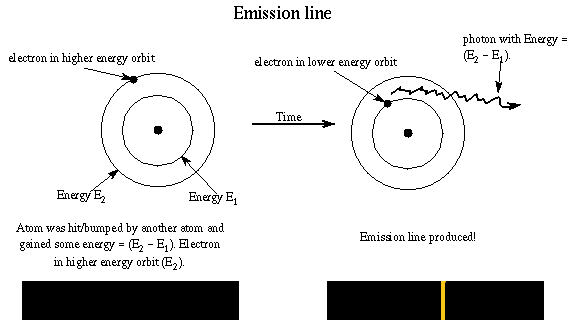
To theorize from the perspective of the frame of reference of the electron, the distance between the electron and the particle that its lost energy is transferred to is nullified. There is no photon to the electron. There is only the receiving particle. The photon is like an accountant that equalizes the difference between extremely diverse temporal frames of reference. In fact, the same formula that describes the difference between temporal frames of reference can also be used to describe the difference in distance between temporal frames of reference. At this point, time and distance become interchangeable.

This effect is extremely common. The light hitting your eyes as you read this is following this same course. The radio signals that you use in your wifi, your cell phone, and countless other devices in this world, are using photons of electromagnetic radiation that follow this same pattern of temporal accounting. There are so many particles of electromagnetic radiation crisscrossing your body at any given moment, that your experience of time is a tapestry of temporal extremes homogenized into a single macroscopic temporal experience. This is such an astonishing thing to consider that scientists have speculated that there is only one electron in the universe and shares its existence throughout all things by virtue of its extreme temporal experience.

In fact, on the most foundational level of matter, the difference between matter and energy becomes interchangeable. Energy, therefore, is a material thing. This is how we were able to develop atomic energy by converting matter directly to energy. At this point, matter doesn’t consist of a tangible substance as we would understand it, but it consists of form itself. For my non-materialist brothers and sisters, it consists of the very thought of God.

And so time and distance are part and parcel of the matter and energy contained within them. You cannot have time and distance without matter and energy. You cannot have matter and energy without time and distance.

I have written all that to arrive at this final conclusion. If God is immaterial, he cannot be in time. At the very least, he cannot be in time as we know it.

So what do we make of Greg Koukl’s argument in the form of the question, “Does God count?” There is a theological statement in the Bible that bears considering: “In the beginning, God created the heavens and the earth.” While many theologians don’t consider God as Creator to be an attribute of God, I do. While creation adds nothing to him, I believe the very fact of creation to be absolute. As such, God as Creator is an absolute attribute. He creates because he is creative. And creation bears his attributes in many different ways so as to glorify him. He magnifies himself in creation. Creation doesn’t materially exist on its own, but every particle of matter and energy with the smallest iteration of time and distance is upheld by the mind of God. God doesn’t count in order to know. God counts in order to create, and what he creates is temporal. If this is true, Greg’s question refutes his implications. God’s counting is the source of temporal creation, not the result of it.


I hope you were able to follow along this far to the end of a longer article than I like to read, much less write. But I hope it has been well worth it for you.

Wednesday, February 5, 2014

What’s the Problem With Science?

If you missed the debate between Ken Ham and Bill Nye, I recommend watching it. It’s live only for a short time and then you’ll need to obtain a DVD of it. Ken Ham’s argument was based on a variety of presuppositional apologetics that applies well to the scientific arena.

In that vein, it’s been a few years since I’ve handled the particulars of the epistemic problems of the scientific method and I’m not even sure where that article resides online anymore as I have blogged in a few different areas in the past several years.

However, many people may find not my language here helpful. I’m neither a rhetorical nor a metaphorical thinker. Many people think in terms of the words that they use to represent ideas. That rhetorical thought. Most people are metaphorical thinkers. They understand more difficult concepts by think of simpler things that are similar in some way to the concept. Most people can hear a clever turn of phrase or a metaphor and it sticks with them because the logic seems to make sense. So, I will vie to explain Ken Ham’s argument, and the problem with the scientific method, in a way that hopefully can be understandable to most people.

Let’s look at the way we perceive the world around us. We have 6 senses, if you include balance. (I don’t know why balance gets left out of the list of normal senses that we have, but it always is: 1) touch 2) sight 3) hearing 4) taste 5) smell… 6) balance. Come one everyone, add it.) We can only perceive anything right now immediately. If I hear you talking in the next room, my ears aren’t in the next room. The sound of your voice has traveled through the air into the area where I am and is causing my ear drums to vibrate. My hearing starts when my ear drums are vibrating. I can put two and two together and reasonably conclude that you are talking in the next room.

Given that sound travels through the air at a certain speed, I am actually not perceiving you in real time. My hearing your voice is delayed by a little bit of time. I know you are in the next room because I don’t see you in the room where I am and it sounds like your voice is coming from elsewhere. I have enough evidence to reasonably conclude that you are in the next room.

But I can be fooled. Someone can set up a speaker system, even in my room, that I’m not expecting your voice to come from. Someone plays your voice such that it sounds like your voice coming from the other room. So I get up and go into the next room and discover that you aren’t there. I was fooled. Magicians capitalize on this kind of misdirection and misperception in order to produce entertaining illusions of the senses.

We experience the world in repeating ways every day such that we can expect to experience things the same way every day. I put on a pot of coffee and it brews the same way it did yesterday. If it doesn’t brew, I check to see what’s wrong and I expect to find the machine unplugged or broken. These are predictable things that I know from repeated experience.

Science works the same way. When we observe the same things using the scientific method over and over, we expect it to be the same way every time. This is called predictability. This is the argument that Bill Nye made and challenged Ken Ham to come up with something that creationism does that is predictable.

The thing is that Ken Ham actually answered his question. However, Bill Nye didn’t understand the distinction. The answer is that scientists who are creationists use the same science that scientists who are naturalists use. So there is the same level of predictability. Ken Ham’s argument actually went further to point out that predictability fall apart at a certain point.

This is the problem with the scientific method. We can be fooled, not only by magicians, but by the limitations of the way that we sense the world around us.

Scientists augment our 6 senses with the use of equipment that helps us detect things that we wouldn’t normally be able to sense naturally. But when detecting things outside of certain limits, our ability to understand what we sense requires that we make certain assumptions. Ken Ham pointed out examples of these assumptions.

The problem is that these assumptions are not testable. That means that we have no way of knowing of these things are true.

One example was radiometric dating. That doesn’t mean that we have radios going out on the town drinking liters of beer instead of pints. Radiometric dating is when the percentage of elements in rocks is measured to see how old they are. The observation is that one element turns into another element over a very long period of time and we can measure this over a very short period of time to calculate how fast it changes. So the theory is that we can measure the two elements to see how much of the one has turned into the other. It sounds pretty cut and dry, right?

Well, there are some assumptions made. The biggest one is that we don’t know if there was any of the second element in the rock to begin with. We have to assume that there was none. But if there was some, then we would conclude that the rock is older than it really is. The fact is that there is no way of knowing. So we really can’t tell how old the rock is. All we really know is what the rock is made up of today.

Everything in science, from the diversity of life on earth to the light coming from distant stars, requires these kinds of assumptions. Depending on what we think we know molds the assumptions that we have. Scientists who don’t believe in God will make certain kinds of assumptions. Scientists who believe in God will make different kinds of assumptions. So when different kinds of assumptions are used to evaluate the same evidence, different conclusions will be drawn.

Ken Ham understands this. Bill Nye does not.

So there is a problem with the scientific method. Bill Nye thinks we can know the history of the world by looking at it scientifically. Sure, we can get close. But it’s reasonable to understand how accurate our conclusions are based on the assumptions we use. Bill Nye thinks he can know for sure because he doesn’t understand how assumptions work. Reasonable people who understand how assumptions work will understand that there is a certain level of uncertainty in scientific conclusions.

But there is a certainty in some assumptions that have been given to us to know. I will address that in some later article series if I get it laid out properly. Stay tuned.

Thursday, May 16, 2013

From Star Trek "Into Darkness" to God's Revelation: Into Light

I’m watching a special on the History Channel that’s investigating physics from observations of the latest Star Trek movie. One statement was made that I think relates to understanding God. One of the contributing physicists made the comment that we don’t know why time dilation exists. This isn’t entirely true. He didn’t qualify this comment, but let me investigate it briefly and then turn to what this means for understanding God.

The speed of light is the speed limit of the universe despite theoretical speculations of warp fields and wormholes. The reason why is related to the production of electromagnetic radiation, aka “light”. Light doesn’t have mass. We can say that light transfers energy. More accurately, it is a pattern of energy manifest in multiple spacetime frames of reference. I’ll keep it as simple as possible:

Energy is transferred from particle of matter to particle of matter when those particles come close enough for their respective systems of forces to influence each other significantly. When a photon of light is produced, the particle that produced it approaches the speed f light and suddenly loses energy. That energy is transferred to the object the photon eventually strikes. As the particle that produced the photon approaches the speed of light in the process, the distance between it and the object that will eventually absorb the photon that is produced is diminished infinitely within the frame of reference of the originating particle. This is called distance contraction and is part and parcel of time dilation. So as far as the source particle is concerned, it hits the receiving particle and thus loses energy.

To the outside observer, no distance ever closed in. What happened is that time dilated for the originating particle and distance contracted. Once the energy transfer happened, the distance snapped back to “normal” and its temporal frame of reference became relatively aligned once again with its surrounding objects. But the distance contraction is represented to the outside observer as a photon and the observation of the originating particle hitting the receiving particle is represented as a difference of time related to the distance. This is the speed of light.

The reason we have time dilation is more easily thought about with a simple thought experiment. If Bonnie and Clyde drive by in their automobile and fire a gun down the road, the velocity of the bullet relative to Bonnie and Clyde is roughly the same as if the vehicle were not in motion. To someone standing by the side of the road, the bullet whizzes by at the velocity of the bullet if the vehicle were not in motion plus the velocity of the vehicle.

But light is different. If it were night time and Bonnie and Clyde had their headlights on, the velocity of the photons being emitted from the front of the vehicle would be precisely the speed of light. To the observer on the side of the road, the velocity of the photons would also be precisely the speed of light. So what happened to the speed of the vehicle? That’s where time dilation comes into play. There is a time differential between the vehicle and the observer on the side of the road that accounts for the difference due to the velocity of the car. That’s time dilation.

Now add to this that a vast spectrum of electromagnetic radiation is passing around us constantly in all directions. We perceive a relatively uniform temporal frame of reference. However, it is anything but uniform. On the subatomic level, time is extremely volatile and changing. If it weren’t, we wouldn’t be able to perceive anything around us. The chemical processes that make our bodies work couldn’t happen. We wouldn’t be able to see the world around us. There would be no life.

Where to go from here? I could talk about creation and how this applies to developing cosmologies. I could talk about how this isn’t often applied very well when people consider the various speculations regarding the beginnings of the universe. But I want to make another observation regarding God’s revelation of himself.

What I’ve written above in very simple and short order is understood by very few people, including some physicists who are interviewed by TV shows. The reason is that most people find it acceptable to relate to and survive in the world with the mere macroscopic perceptions available to us. Most people couldn’t tell you how a simple radio works, but they know how to use one.

God revealed himself to us in a very practical way. In this way, even many intellectually challenged people can grasp the basics about God. However, the depth of information included is enough to make the brightest among us wrestle with some of the issues he revealed to us. Most people are able to function quite well with the information God has provided although some concepts are difficult and present apparently conflicting concepts.

The fact is, God knows the range of intelligence of the creatures that bear his image and planned on giving us all enough to warrant a knowing faith as well as keep us learning about him for a lifetime. The Great Commission is more than simply leading someone into the Kingdom. The Great Commission is more than simply teaching a new believer the basics. We are all to be disciples until we pass from this world.

Wednesday, January 23, 2013

A Response From an Embarrassingly Ignorant Young Earth Creationist

I was listening to Dr. William Lane Craig’s recent podcast where he was commenting on a discussion between theistic evolutionist, Francis Collins, and atheist Richard Dawkins. You can listen to it here.

At 7:51 Craig said, “…over 50% of evangelical pastors think that the world is less than 10,000 years old. Now when you think about that… that is just hugely embarrassing… This is just scientifically nonsense and yet this is the view that the majority of our pastors hold. It’s really quite shocking when you think about it.”

Well, I’m not a pastor, so perhaps I’m not quite as embarrassing. But what I find embarrassing is Dr. Craig’s apparent ignorance regarding the epistemic problems with scientific conclusions. He says two things that demonstrate some incoherence in his understanding of revelatory epistemology:

At 3:54, “I would agree… that you ought to exhaust the naturalistic hypotheses first before opting for a supernatural hypothesis.”

At 13:24, “With regard to Christian faith and practice I would say you need first and foremost to do your biblical hermeneutics responsibly and objectively. You need to not interpret the Bible in light of modern science, but to interpret it according to what its original author and original audience would have understood. That’s the first and foremost task is to interpret the Bible objectively and correctly. Then the second task will be trying to integrate what we learn from the Bible with the worldview of modern science so as to have a sort of synoptic worldview that takes into account all that we’ve learned, not only from divine revelation, but from God’s revelation in nature – in the book of nature. And then we will build a synoptic sort of worldview that makes the best sense of the data.”
It’s this incoherence that makes Dr. Craig a prime example of something Dr. K. Scott Oliphint, professor of Apologetics and Systematic Theology at Westminster Theological Seminary, said in a recent interview. It’s worth listening to, which you can do here.

Continuing with Dr. Craig’s podcast, he goes on to say at 9:35,

“What would hurt the Bible would be if the Bible intends for us to believe that the world is only 10,000 years old and therefore comes into conflict with the best evidence of modern science. That’s what would hurt the Bible. What would not hurt the Bible would be if it could be shown that the Bible doesn’t take a position on how long the universe has been around. Then it wouldn’t be damaged by scientific evidence, or the geological age of the earth, or the age of the universe.”

Then Craig knocks Francis Collins for believing in theistic evolution. What difference does Craig see in the science that he feels supports an old earth and the science that is used to support evolution? From a scientific standpoint, they are equally unscientific if for no other reason than they have not been observed and cannot be tested. Those aren’t the only things wrong with the science, and I’ve already pointed to problems with the science behind the age of the earth in previous articles.

He continues in his incoherence by agreeing with Bill Nye (the Science Guy) that we should not teach our children about a young earth, but he believes that we should teach our children about the controversy surrounding evolution:

At 15:45, “I would not disagree with [Bill Nye] that we ought not to teach our children that the world is only 10,000 years old. I think that that’s not something that the Bible imposes on us, and it’s not supported by modern science, so I would agree that… we shouldn’t teach that to our children. But we should certainly teach them that there is a Creator of the universe who is God and who brought the universe into being and designed it in such a way as to support the existence of human life. And with regard to how human life and biological complexity came to be on this planet, I think we need to teach the children the controversy; teach them the various views that are held today so that they are conversant with the neo-Darwinian theory of evolution and can discuss it even more intelligently than their peers with regard to its pros and cons. And then teach them a range of alternatives that are available for the objective Bible-believing Christian today.”

But I want to go back and explain a little further how his comments about biblical hermeneutics are incoherent. If you take the first chapter of Genesis at face value without considering any modern scientific thought, you must conclude that days it refers to are solar days. If we look at the scientific investigation used to date the earth as very old, every last conclusion regarding the age begins with the assumption that the earth is very old. The scientific discovery is employed to determine how old. You can’t do radiometric testing on rocks without assuming the ionic percentages that made up the rocks at the time they were formed, which you assume was millions of years ago. You can’t construct a geologic column unless you assume that the layers were deposited over millions of years. Therefore, in order to use the conclusions of scientific endeavors such as these to controvert a plain reading of the biblical text and substitute a figurative reading of it, you have to assume that plain reading is inaccurate a priori.

Scientists are just as adamant that macro-evolution is just as certain as an old earth. The only reason Craig can say that the science behind old earth is beyond reproach where macro-evolution is not is because the text of the Bible can more easily be subverted to agree with an old earth than it can with macro-evolution. Perhaps another reason he gives is found is this comment:

At 8:37, “…the young people in their congregations [of pastors who hold the view that the Bible teaches a young earth] are convinced that the pastor is right that the Bible teaches this, but they are convinced by their geology teacher or the earth science teacher that the world is older than that, that means ‘give up the Bible and walk away from the Christian faith’.”

So does Dr. Craig mean that we need to be old earthers so that our young people won’t leave the church? It’s not clear that he means this, but I see no good reason for saying it otherwise.

Finally, it seems that Craig misses the fact that the modern scientific industry is founded on an assumption that the Bible isn’t true.

At 3:08, “But here he takes the rather cheeky position that the reason that they opt for the multiverse is to avoid a Creator which is, in fact, what Stephen Hawking has actually said in his book, The Grand Design.”

You can’t harmonize a Biblical worldview with conclusions that are founded on an assumption that the Bible isn’t true. There is a way to do science that recognizes the veracity of the Bible. This is where science was historically rooted. But the modern scientific academy rejects any but science that makes naturalistic assumptions. Craig acknowledges this on one level, but then tries to mix it with how to understand the Bible on the other. This is the most egregious error in his thinking.

Monday, November 19, 2012

Old Earth Theology – What the Early Church Fathers Taught


This is the final post on a series about Old Earth Theology. This first post is here.

The teachings of the early church fathers are not part of the inspired text. However, as the beginning of our church traditions, they are a study in how orthodox Christianity is understood and taught. So it is interesting to see how the church fathers interpreted Genesis 1.

To this end, there is a good book out that has a chapter that discusses it. It’s entitled Coming to Grips with Genesis: BiblicalAuthority and the Age of the Earth. It’s a collection of 14 articles by various authors in support of YECm. The first chapter written by James Mook details the teaching of the early church fathers on Genesis 1.

Dr. John Millam, an OEC, has a reasonable critique ofMook’s article. I always like to balance arguments with critiques and responses from the opposing side. The side who ignores good arguments from the other side is suspect. While Millam has a good critique, it’s not sufficient as an argument for OECm. Some of the church fathers taught that the days were 24-hour periods of time. Some taught that they were figurative periods of time. In looking at the evidence, however, I found out that the figurative “days” in Genesis 1 were never explicitly taught as long periods of time prior to Adam and Eve. Instead, they taught them as a type of eschatology.

I have never heard of this before, so I have had to study this. This type of eschatology was widely held by various Jewish sects although they differed on the particulars. It was especially popularized by the rise of the teaching of the Kabbalah, a school of thought that taught a form of mystical exegesis. Some scholars argue that the Kabbalah was the origin of the doctrine of the Trinity. I think that theory is in error. But I also think that mystical exegesis is in error. Although the Kabbalah helped popularize the eschatology of Genesis 1, that understanding doesn’t rely on the Kabbalah for validation.

In fact, varieties of eschatology that use Genesis 1 are different enough that it’s not wise to speculate on eschatology on that alone. However, whether the church fathers were YECs or not, it seems most likely that the eschatological understanding was more important to them. Given that one of the differences concerned the day the Messiah was to come, the church fathers certainly understood that he had already come in the person of Jesus Christ.

But I’ll say it again: none of the church fathers taught any form of an old earth creation. Granted that there are problems with using them to support a young earth as Millam has pointed out, but even some of Millam’s arguments are questionable. For example, he argues that while the early church fathers never taught an old earth, he doesn’t think that they would have rejected it either. The appeal to this comes oddly after an attack on their hermeneutics as apparently being vastly different. You can’t have it both ways. If you say that someone’s interpretive method is questionable, you wouldn’t want to say that you think they would have supported your position as evidence that your position is correct. So obviously Millam respects the church father’s understanding of scripture. Given that never taught OECm, and some were explicitly YECs, then the evidence suggests that as a body, they would more likely have accepted YECm.

Additionally, given that some taught that the “days” of creation were allegorical of all of creation, they believed that creation consisted of about 6000 years with a seventh indefinite period of time after the resurrection. What aspects of that are accurate is a different discussion. It’s intriguing to think that perhaps the millennium in Revelation 20 refers to the sixth or seventh day of creation. Just don’t tell the strict dispensationalists. That could stir up a hornet’s nest.


Thursday, November 15, 2012

Old Earth Theology – Who Is Making the Arguments

My first post on this series is here.

There are two basic sets of arguments that contribute to an old Earth theology. The first set contains arguments that are scientific in nature. The second set contains arguments that are theological in nature. Quite simply, there are two different groups that make each of these arguments.

Naturalists and Theistic Evolutionists

The mainstream scientific school of thought is dominated by scientific thought that relies on naturalistic presuppositions. That means that before any conclusions are drawn from testing, any supernatural explanations are automatically denied. The untested theory is that the supernatural cannot be empirically tested. The non sequitur conclusion is that only natural explanations are possible.

It is from this philosophy of science that Darwinian evolution draws it’s a priori conclusion. So the question is not whether organisms evolved naturally from inanimate matter. The question is how they evolved from inanimate matter.

Given that even non-biological science is naturalistic, sciences that are not directly related to Darwinian evolution still assume that Darwinian evolution occurred. Therefore, when physicists and geologists test to determine the age of the earth, they must assume that it is old enough for life to have evolved. Therefore, any evidence that the earth is young is dismissed as anomalous or not yet explained.

There are naturalists who otherwise believe in a supernatural Creator. Some may even be Christian. However, they hold any claims of Christianity to be untestable because they don’t fit into the naturalistic presuppositions that they have been taught define science. If you want to work in mainstream science you largely have to buy into naturalistic presuppositions to be accepted.

Non-Evolutionists

The theists who argue for an old earth are the ones who argue from a scriptural standpoint. The question I have always asked is why they argue for an old earth when the scriptures don’t explicitly teach that. The plain reading of Genesis 1 is that God created the earth in 7 rotations of the earth as denoted by the period of the sun. In fact, these theologians go out of their way to deny that Genesis 1 doesn’t mean what it seems to say.

The only reason I can think of why they do this is that they have heard some of the evidence for an old earth and an old universe and are convinced by it enough to see if the scriptures make allowance for the current mainstream science on the matter. What I haven’t heard a single one in this group address is the evidence for a young earth. The only thing I can conclude is that they haven’t heard the evidence for a young earth because mainstream scientists typically don’t address it.

The Science Isn’t Conclusive


The thing is, there is some compelling evidence out there that the earth is relatively young. Not all scientists are naturalistic. Some Christian scientists actually work on the fringes and conduct experiments using science that is based on non-naturalistic presuppositions. That means that they allow that there may be a God.

Answers in Genesis has been a clearinghouse for non-naturalistic science, particularly as it relates to the origins of the universe, the earth, and life. Recently, they have been repackaging some of the leading evidences for a young earth. I’ll repost their top ten list here:

  1. Very little sediment on the seafloor
  2. Bent rock layers
  3. Soft tissue in fossils
  4. Faint sun paradox
  5. Rapidly decaying magnetic field
  6. Helium in radioactive rocks
  7. Carbon-14 in fossils and diamonds
  8. Short-lived comets
  9. Very little salt in the sea
  10. DNA in “ancient” bacteria

Another consideration that I think trips many people up is the age of the universe versus the age of the earth. Many scientists, much less laymen, think that time throughout the universe passes relatively uniformly. In our day-to-day life it certainly seems so, so it’s understandable that it’s a difficult concept for most people to grasp.

But vast differences in the passage of time are far more common than most people think. The spectrum of electromagnetic radiation (visible light and various radio waves) is nothing but temporal distortions generated by subatomic interactions that approach the speed of light. What I’m trying to say is that the universe could easily have been created after the earth and aged so fast that it appears older than the earth. It’s not scientific fiction and actually explains a few things that the Big Bang theory can’t account for. There are some that think this theory is far-fetched, but it’s actually a more likely explanation for the evidence than the Big Bang.

What I’m trying to say is that there’s no good reason to believe the naturalists on the age of the earth without question. They have some legitimate observations that can’t be ignored. But those observations have their own problems. Naturalistic science should be scrutinized. Theology that goes out of its way to accommodate it should be scrutinized as well.

My next (and last) article in this short series will discuss what the early church fathers taught regarding Genesis 1. You might be as surprised as I was when I first read it.

Monday, November 12, 2012

Old Earth Theology

As a matter of full disclosure from the beginning of this, I’ll let it be known that I’m a Young Earth Creationist (YEC – I’ll refer to Old Earth Creationists as ‘OEC’).

Additionally, to limit any discussion to the topic at hand this series is about the differences between Old Earth Creationism (OECm) and Young Earth Creationism (YECm) between Christians. It will involve some of the science surrounding this topic and will assume that naturalistic evolution has not occurred. So that eliminates discussion of theistic evolution. It’s not that I get many commenters here, but I have a very specific topic that I wish to discuss. I won’t entertain discussion otherwise here.

I have thought about this for a number of years now. The topic of the age of the earth is one that seems fraught with a lack of understanding. Most of the time when I read or hear an OEC explain why he or she believes OECm, the rationale typically given is limited to arguments regarding the exegesis of Genesis 1.

The problem with this approach is that an exegesis of Genesis 1 devoid of scientific considerations results in interpreting each ‘day’ as a single rotation of the earth. In other words, the exegetical arguments that result in a gap between verse 2 and 3 (the Gap Theory), or interpreting each of the days as referring to very long unspecified periods of time, are obviously informed by some information that the OEC isn’t disclosing.

The reason it seems is that OECs think it goes without saying that science has absolutely proven that the earth is old, but they aren’t prepared to discuss the science because they are theologians, not scientists. They haven’t studied the science in any depth, but what they have seen appears to have been pretty convincing to them. Most OECs that I have read or heard merely dismiss the science with statements such as “Well, Genesis 1 isn’t a science textbook.” I can only interpret that to mean, “I don’t understand the science, but it seems to me that scientists have proven that the earth is very old. Genesis can be interpreted different ways. It’s not a deal-breaker. Therefore, I can say that the earth is very old without changing the gospel. That’s so scientists don’t think I’m an idiot and other Christians won’t think I’m a heretic.”

The view of YECm is that a plain reading of the scriptures are that the days are single rotations of the earth and that the science isn’t conclusive.

The only non-theistic evolution OEC that has addressed the science that I have seen merely said that the science for the age of the earth is not encumbered with the same naturalism as Darwinian evolution is. Therefore, he concluded, we can accept the conclusions without delving into the intent of the scientists. The only problem I have with that is that many of the scientists whose work contributes to calculations of the age of the earth are Darwinian evolutionists otherwise and invested in an old earth a priori to testing and analyzing data.

The point of this article is simple. I have some sources that I have reviewed regarding arguments for OEC. But I may not have them all. I have reviewed plenty for the exegesis of Genesis 1, but can find very little other than what I have mentioned for importing scientific conclusions into the exegesis of Genesis 1. If anyone reading this knows of some better argument for OECm, please let me know. I’d like to interact with it and post my findings. I’m looking for the best arguments for OECm if any are out there that I haven’t found. Post links or resources in the comments and I will review what I understand.

What I plan to cover in the future is how the early church fathers handled Genesis 1 (in general) and how the science is not conclusive. If anyone comes up with a better argument than I have seen, I’ll include it as well.

Edit:
The second article discussing who (in general) is making the arguments can be found here.

Tuesday, June 5, 2012

Does Science Tell Us How To Interpret the Bible?

Here is a great impromptu panel debate on a TBN program, Praise the Lord. I'm not typically a watcher of TBN. It's Christianity "light" and open to all sorts of ministerial lunacy. This seems to be one instance where they accidentally let in a couple of people who knew the Bible and were willing to stick up for it.

Young Earther, Ken Ham, sticks it to Old Earther, Dr. Hugh Ross, with interaction by such names as Ray Comfort, Dr John Bloom, Sean McDowell, and Eric Hovind. It's worth watching and thinking about.


BTW, I'm a Young Earther. I believe it's possible for the rest of the heavenly bodies to be older than the earth and have been created after the earth and for the light to make it to earth. I think God could pull this off easily and that it could even happen without breaking the laws of physics. I don't think the current understanding of physics is particularly well advanced. We'll get there if physicists can set aside some of the unrelated philosophical presuppositions that they are using as models for proposing cosmological theories.

The debate boils down to the nature of revelation. For Ken Ham, The Bible is authoritative as the revelation of God. For Dr. Ross, natural revelation is equal to the Bible as authoritative. I agree with Ken Ham. Sola Scriptura.

ht: Answers in Genesis